How Many 48V Lithium Batteries Do You Need for A Home Solar System?
You are here: Home » Blog » How Many 48V Lithium Batteries Do You Need for A Home Solar System?
How Many 48V Lithium Batteries Do You Need for A Home Solar System?
Views: 0 Author: Site Editor Publish Time: 2026-10-24 Origin: Site
One 48V battery may support several essentials. A whole home can require eight or more.
The difference comes from energy use, backup duration, and each module’s usable capacity. A 48V Lithium Battery must also handle demanding household loads.
Ocean Solar was established in 2012 and serves global off-grid and grid-connected solar projects. Its portfolio covers panels, inverters, energy storage, and customized solar solutions.
This guide explains the calculation, practical examples, and system checks needed before selecting your battery quantity.
Quick Answer: How Many 48V Lithium Batteries Does a Home Need?
Many home solar systems need two to eight 48V-class lithium batteries. However, the correct number depends on the loads you plan to protect.
Two 5.12kWh batteries may cover basic lights, refrigeration, internet equipment, and small electronics overnight. Three or four modules better suit broader essential-load backup. Six to eight modules may support larger loads or near whole-home operation.
These ranges assume 51.2V 100Ah batteries, each storing 5.12kWh of nameplate energy. They also assume 80% planned depth of discharge and 90% delivery efficiency.
Daily Energy Needed
Required Nameplate Capacity
5.12kWh Battery Count
5kWh
6.94kWh
2
10kWh
13.89kWh
3
15kWh
20.83kWh
5
20kWh
27.78kWh
6
28.4kWh
39.44kWh
8
The final row reflects approximately one average day for a U.S. residential customer. The U.S. Energy Information Administration reported 865kWh average monthly consumption during 2024, equaling about 28.4kWh daily.
That national figure should never replace your electricity bills. Climate, heating type, air conditioning, water heating, and electric vehicles create major differences.
Whole-home daily consumption is not always the correct storage target. Grid-tied owners may only protect a critical-load panel during outages. Solar self-consumption users may store afternoon surplus for evening use. Off-grid owners usually need longer autonomy because no utility supply remains available.
Seasonal conditions matter as well. Winter heating can increase demand while shorter days reduce solar production. Summer cooling may create both high energy use and severe compressor startup loads.
A better question is not simply how many batteries power a house. Ask how many batteries support your selected loads for the required hours.
Calculate Your 48V Lithium Battery Bank Step by Step
Measure Daily Energy Instead of Guessing from Inverter Size
Start with household energy use in kilowatt-hours, not inverter power in kilowatts. Power describes how much equipment can run simultaneously. Energy describes how long the equipment can keep running.
Review twelve months of electricity bills when sizing whole-home storage. For backup systems, list only essential appliances and their daily operating hours.
Use this basic appliance formula:
Daily energy in kWh = appliance watts × operating hours ÷ 1,000
A 150-watt refrigerator averaging eight equivalent hours uses about 1.2kWh daily. A 1,200-watt pump running two hours uses 2.4kWh. Add every protected load before applying design allowances.
Choose Backup Time and Usable Capacity
Next, select your desired days of autonomy. Grid-tied backup may require only one night. Remote off-grid solar systems may need two or three low-sun days.
Then correct for depth of discharge and system losses:
Required nameplate capacity = daily load × autonomy days ÷ planned DoD ÷ system efficiency
Suppose your selected loads consume 12kWh daily. You want one backup day, 80% planned DoD, and 90% delivery efficiency.
12kWh ÷ 0.80 ÷ 0.90 = 16.67kWh
Now divide by one battery’s rated energy:
16.67kWh ÷ 5.12kWh = 3.26 batteries
Always round upward, so this 48V LiFePO4 battery bank needs four modules. Two autonomy days would double the energy requirement to eight modules.
Confirm the Manufacturer’s Usable-Energy Limit
The 80% DoD assumption supports conservative planning, but it is not universal. Some batteries permit deeper regular discharge. Others reserve more capacity for protection and service life.
Use the approved DoD, operating voltage, and efficiency from current data sheets. Also allow extra capacity for aging, winter production, and expected household growth.
A design margin of 10% to 20% may help where loads change frequently. Avoid adding a percentage without understanding its purpose. Oversizing increases cost, while undersizing causes deeper cycling and shorter backup periods.
For an existing solar system, compare recent inverter monitoring data against utility bills. This check reveals daytime direct solar use, nighttime demand, grid imports, and seasonal production gaps.
Worked Example Using a 51.2V 100Ah Lithium Battery
Most products marketed as 48V LiFePO4 batteries use a 51.2V nominal design. Sixteen 3.2V LFP cells in series create this operating platform.
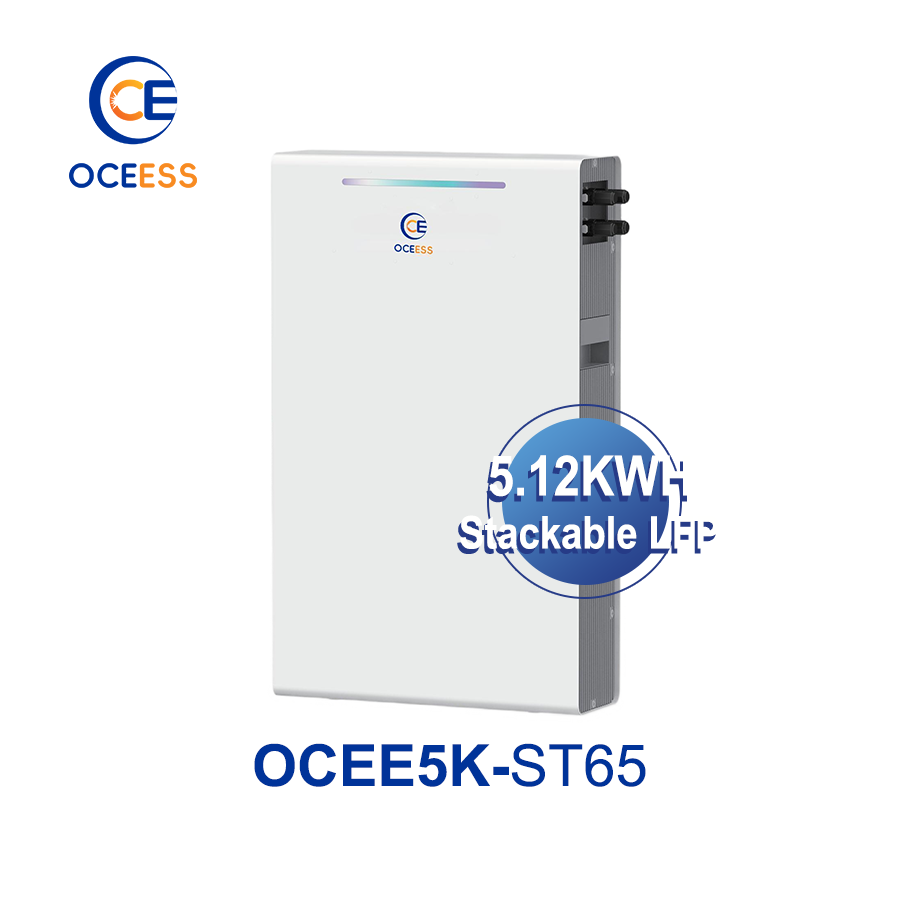
The Ocean Solar OCEE5K-ST65 5.12kWh battery uses a 51.2V, 100Ah configuration. It includes an intelligent BMS, CAN/RS485 communication, and supported parallel expansion.
Its published limits include 50A continuous charging and 100A continuous discharging. It also lists a 150A pulse rating for one second.
Convert One Module into Practical AC Energy
Nameplate storage equals voltage multiplied by amp-hours:
51.2V × 100Ah = 5,120Wh, or 5.12kWh
Using 80% planned DoD and 90% inverter efficiency gives this practical estimate:
5.12kWh × 0.80 × 0.90 = 3.69kWh delivered AC energy
Battery Modules
Nameplate Storage
Estimated Delivered AC Energy
1
5.12kWh
3.69kWh
2
10.24kWh
7.37kWh
3
15.36kWh
11.06kWh
4
20.48kWh
14.75kWh
6
30.72kWh
22.12kWh
8
40.96kWh
29.49kWh
These figures are planning estimates, not guaranteed outputs. Temperature, cable losses, inverter loading, battery age, and standby consumption affect delivered energy.
Runtime changes quickly when large resistive loads operate. One estimated 3.69kWh module could run a 300-watt average load for about twelve hours. A steady 3kW load may exhaust that same delivered energy in roughly seventy-four minutes.
Real homes cycle appliances on and off, so fixed-load examples remain simplified. Smart monitoring provides a better load profile for refrigerators, pumps, air conditioners, and electric cooking equipment.
Check Power Before Choosing the Final Quantity
One 51.2V module rated for 100A continuous discharge provides about 5.12kW of DC power. After conversion losses, available AC power will be lower.
Several batteries may increase current capability when the manufacturer approves parallel operation. However, inverter limits, current sharing, busbars, fuses, and communication settings can restrict total output.
A four-module bank may contain enough energy for an evening. It can still trip if a pump and air conditioner start together.
Match the Battery Bank to the Inverter and Solar Array
Verify Inverter and BMS Compatibility
A 48V home solar battery bank must match the inverter’s operating voltage range. It also needs approved charging voltages, current limits, and communication protocols.
CAN or RS485 communication lets the BMS share state of charge, temperature, alarms, and current limits. Without correct communication, an inverter may apply unsuitable settings or display inaccurate capacity.
Ocean Solar offers panels, inverters, energy storage, and customized solar solutions. This system-level range helps buyers evaluate battery capacity beside generation, conversion, and control requirements.
Before purchasing, confirm these specifications:
The inverter supports the battery’s full operating voltage range. Its continuous rating must cover normal simultaneous loads. Its surge rating must start compressors, pumps, and motors safely.
The BMS communication protocol matches the inverter firmware. The approved battery list should identify the correct model. Installer settings must follow the latest manuals.
The total battery discharge current supports the inverter demand. Cables, busbars, breakers, and disconnects need suitable current ratings. Parallel modules require balanced paths.
Size Solar Production for Daily Recharging
A large battery bank cannot fix an undersized solar array. The panels must supply household daytime loads and replace energy removed overnight.
Use this planning formula:
Solar array kW = daily recharge energy ÷ peak sun hours ÷ solar-system efficiency
Suppose the battery must replace 15kWh daily. The site receives five peak sun hours, and the charging path operates near 80% overall efficiency.
15kWh ÷ 5 hours ÷ 0.80 = 3.75kW of solar
This result covers battery replacement energy only. Add daytime household consumption, seasonal weather allowances, shading losses, and charging-current restrictions.
The battery’s maximum charge current may also slow recovery. Adding modules increases energy capacity, but the array and inverter must recharge them before the next discharge period.
Check whether the charge controller can use the array’s full output at 48V. Its voltage window must accept the planned panel string. Its output-current rating must also remain within the combined battery charge limit.
Generator charging requires another review. The charger, generator, and battery bank must share compatible power and current limits without overloading any component.
Avoid Common Sizing Mistakes and Plan Safe Expansion
Separate Energy Problems from Power Problems
Many buyers size a battery bank from the inverter label alone. A 10kW inverter does not automatically require a fixed battery quantity.
It needs enough battery current for its maximum demand. It also needs enough stored energy for the intended runtime. Both checks are necessary.
The table below highlights frequent home solar battery bank sizing errors:
Sizing Mistake
Why It Causes Problems
Better Approach
Comparing amp-hours alone
Amp-hours ignore system voltage
Compare stored and usable kWh
Using nameplate capacity as usable energy
DoD limits and losses reduce delivery
Apply approved DoD and efficiency
Ignoring motor startup
Pumps and compressors create short surges
Check inverter and BMS peak ratings
Adding autonomy without more solar
Larger banks may not recharge fully
Resize panels and charging capacity
Mixing batteries without approval
Different ages or BMS settings may imbalance
Follow the manufacturer’s expansion rules
Using unequal parallel cables
Current may not divide evenly
Use balanced cable lengths and busbars
Leave Room for Growth Without Oversizing Today
Modular 48V lithium batteries make staged expansion practical. Start with a verified essential-load design, then add approved matching modules as demand grows.
Plan the original equipment for future current and capacity. The inverter, enclosure, busbars, protection devices, floor space, and communication ports should support the intended final bank.
Avoid combining different voltages, chemistries, capacities, or unsupported firmware versions. Some manufacturers also restrict mixing batteries from different production periods.
Require a Complete Installation Review
Ask the supplier or installer for a documented energy balance. It should show daily loads, autonomy, usable capacity, solar recharge energy, and seasonal assumptions.
The design should also include conductor sizing, overcurrent protection, isolation, grounding, ventilation, and local code compliance. High-current DC systems can create severe arc and fire hazards.
A qualified professional should verify the final design. This review is especially important for whole-home backup, off-grid systems, and large parallel battery banks.
Conclusion
The answer is rarely one fixed number. For 5.12kWh modules, two or three batteries may cover essential loads.
Four to six modules suit broader backup needs. Eight may approach one average household day under conservative assumptions.
Calculate actual kWh, autonomy, DoD, and losses first. Then verify power, inverter communication, solar recharge capacity, and installation safety.
FAQs About 48V Lithium Batteries for Home Solar Systems
Q: How many 48V 100Ah lithium batteries can power a house?
A 51.2V 100Ah battery stores about 5.12kWh. Under 80% DoD and 90% efficiency, it delivers about 3.69kWh of estimated AC energy. A home needing 10kWh requires three batteries. A home needing 20kWh requires six. Always round upward and check actual load data.
Q: Is a 51.2V battery considered a 48V Lithium Battery?
Yes. A 51.2V nominal LiFePO4 battery is commonly sold as a 48V-class battery. It usually contains sixteen 3.2V LFP cells in series. Confirm the full operating voltage and charging settings before pairing it with any 48V inverter.
Q: How many 48V batteries are needed for a 10kW inverter?
Inverter size alone cannot determine battery quantity. You must check the required DC current, each battery’s continuous discharge limit, expected runtime, and usable kWh. The inverter may need several parallel modules for current capacity, even when one module stores enough energy for a short load.
Q: Should 48V lithium batteries be connected in series or parallel?
Complete 48V-class batteries are normally connected in parallel to increase capacity while keeping voltage unchanged. Do not place them in series unless the manufacturer explicitly approves it. Use matching modules, equal cable paths, proper protection, and supported BMS communication.
Q: Can I add another 48V battery later?
Many modular systems support later expansion. Confirm the maximum parallel quantity, battery age rules, firmware requirements, and master-slave configuration first. The new module should usually match the existing voltage, chemistry, capacity, and model. Recheck inverter and protection ratings after expansion.
Q: How much solar power is needed to recharge a 48V battery bank?
Divide daily recharge energy by peak sun hours and system efficiency. Replacing 15kWh during five peak sun hours at 80% efficiency needs about 3.75kW of solar. Add daytime loads, weather margin, shading, and battery charge-current limits before finalizing the array.
 English
 العربية
 Русский
 Español
 Português
 Deutsch
 italiano
 日本語
 Nederlands
 Tiếng Việt
 ไทย
 Polski
 Türkçe
 ພາສາລາວ
 ភាសាខ្មែរ
 Bahasa Melayu
 ဗမာစာ
 தமிழ்
 Filipino
 Bahasa Indonesia
 magyar
 Română
 Čeština
 Српски
 हिन्दी
 فارسی
 Slovenčina
 Slovenščina
 Norsk
 Svenska
 українська
 Ελληνικά
 Suomi
 עברית
 Dansk
 اردو
 বাংলা
 Hrvatski
 Eesti keel
 සිංහල
 latviešu
 Azərbaycan dili
 Български
 ગુજરાતી
 ಕನ್ನಡ
 Kurdî
 Lietuvių
 മലയാളം
 मराठी
 پښتو
 తెలుగు


 简体中文