Why Are More Middle Eastern Households Choosing All-in-One Solar Storage Systems?
You are here: Home » Blog » Why Are More Middle Eastern Households Choosing All-in-One Solar Storage Systems?
Why Are More Middle Eastern Households Choosing All-in-One Solar Storage Systems?
Views: 0 Author: Site Editor Publish Time: 2026-08-12 Origin: Site
1. The Energy Dilemma in the Middle East: Traditional Power Supply Fails to Meet Modern Household Needs
1.1.1 Dual Challenges of Geography and Infrastructure: Frequent Power Outages Become a Common Pain Point
1.1.1.1 Aging Regional Grids and Uneven Coverage Lead to Routine Load Shedding
According to the MENA Energy Outlook 2026 industry report, the Middle East region shows significant polarization. While wealthy Gulf nations like Saudi Arabia and the UAE have relatively sound urban grids, suburban villas and rural residences still experience 4-6 hour power cuts during summer peak AC usage. In contrast, regions affected by geopolitical conflicts like Iraq, Lebanon, and Syria suffer from long-term damage to main grid lines. Ordinary families in these areas face 7-19 hours of daily power outages, making it impossible to run basic cooling, water purification, and lighting systems continuously.
Traditional power grids can only guarantee short-term power supply during the day. Large-scale power outages at night or during peak heat periods can cause high-power equipment such as swimming pool circulation pumps in villas to lose power, whole-house air conditioning, home water purifiers, and refrigerators—offline, causing direct economic losses. Consequently, ordinary families urgently need independent home energy storage systems to break free from reliance on a single grid.
1.1.1.2 Soaring Costs and Drawbacks of Traditional Diesel Generators
Geopolitical tensions continue to drive up local diesel and gasoline prices in the Middle East. Between 2025 and 2026, regional fuel prices surged by over 130%. A 10kW diesel generator suitable for a villa can cost $200-$400 per month in fuel alone. Furthermore, diesel equipment is noisy, produces heavy exhaust pollution, and poses fire hazards if placed in courtyards or indoors. Old generators have high failure rates, and repair parts can take 1-2 weeks to arrive, resulting in extremely poor emergency power stability.
Local residents are desperately seeking zero-fuel, low-maintenance, and stable 24/7 power alternatives. All-in-one solar storage systems equipped with reliable, high-quality lithium energy storage batteries perfectly address all the shortcomings of diesel generators.
1.1.2.1 Continuous High Temperatures Over 45°C: AC Consumption Occupies 80% of Household Power
The Middle East experiences high temperatures for over 6 months a year, with roof and ground temperatures reaching up to 55°C. Residential central air conditioning runs 24/7, accounting for 75%-85% of total household electricity consumption. Grid design capacities have not kept pace with this rising cooling demand. Every year from June to September, countries face peak power deficits and are forced to implement rolling blackouts. Ordinary families cannot maintain a basic comfortable living environment, making home energy storage systems a rigid demand.
1.1.2.2 Harsh Hardware Standards for Storage Equipment in High Temperatures
Industry lab data shows that when ambient temperatures consistently exceed 35°C, ternary lithium battery capacity degrades by 25% annually, with a thermal runaway trigger temperature of only 210°C, posing a fire risk if placed outdoors in the Middle East. Ordinary lead-acid batteries see their lifespan shortened by 70% in 40°C environments.
In contrast, LiFePO4 (Lithium Iron Phosphate) energy storage cells have a thermal runaway threshold of 270°C and can operate stably in the -20°C to 60°C range, making them the only suitable cell type for the Middle East's high-temperature environment. Quality lithium battery manufacturers optimize heat dissipation structures specifically for desert climates to ensure long-term stability.
1.2 Multiple Benefits Overlap: Core Advantages of Installing All-in-One Solar Storage in the Middle East
1.2.1 Implementation of New Energy Support Policies Reduces Costs
1.2.1.1 Gulf Clean Energy Strategies: Tax Breaks and Low-Interest Loans
Saudi Arabia's "Vision 2030" plans for 50% renewable energy generation by 2030. It cancels import tariffs on residential distributed solar storage equipment, and the Industrial Development Fund offers a specialized 7-year loan at an ultra-low interest rate of 2.5%. The UAE's "Energy Strategy 2050" covers 30% of initial installation costs for villa solar storage. Egypt and Iraq have simplified PV approval processes, shortening permit processing from six months to just 7 working days, significantly lowering the barrier to entry for ordinary families.
These policy dividends have directly boosted procurement willingness. In 2025, Middle East household all-in-one solar storage installations rose by 83.7% year-on-year. Major global lithium battery manufacturers are accelerating their layout in the Middle East household storage sector, launching localized products.
1.2.1.2 Net Metering Mechanism: Selling Surplus Power for Long-Term Returns
Lebanon, Saudi Arabia, and the UAE have fully implemented net metering policies. Excess power generated by rooftop PV during the day can be fed into the public grid, with electricity companies settling bills monthly. A 10kW PV system paired with a 10kWh home energy storage system can self-consume 70% of PV power and sell the remaining 30% to the grid. The entire installation cost can be recouped in 5-7 years, followed by 20 years of zero electricity bills or even positive returns—a long-term economic value far exceeding that of diesel generators.
1.2.2 Unrivaled Solar Resources: Leading Global Efficiency
1.2.2.1 Ultra-High Annual Sunshine Hours: Lowest Global LCOE
The Middle East generally sees over 3,000 hours of sunshine annually, with a daily average solar irradiance of 5.4kWh/㎡. Saudi Arabia's PV Levelized Cost of Energy (LCOE) is as low as $0.076/kWh, making it the most cost-effective region globally. Daytime PV panels generate power efficiently, which is stored by integrated energy storage batteries, achieving daytime generation and nighttime supply. This allows for complete independence from the municipal grid, serving as a universal solution for both off-grid and on-grid families.
1.2.2.2 Integrated Design for Diverse Housing Scenarios
Traditional split systems (PV panels, inverters, and batteries from different manufacturers) often suffer from incompatible communication protocols. In high-temperature, dusty environments, wiring connections easily oxidize and short-circuit, requiring 2-3 on-site repairs annually.
In contrast, all-in-one solar storage systems are developed as a whole by a unified lithium battery manufacturer. The PV, inverter, storage, and BMS management system are perfectly matched and debugged at the factory. On-site installation requires only simple fixing and wiring, reducing line failures by 85%. This design fits various scenarios, including Middle Eastern villa roofs, apartment balconies, and courtyard mini-PV setups.
1.3 Core Advantages: Precisely Matching Middle Eastern Living Needs
1.3.1 Stability Surpassing Traditional Solutions: 24/7 Whole-House Protection
1.3.1.1 EPS Millisecond Emergency Switching
Diesel generators take 3-5 minutes to start, during which time refrigerator contents spoil and room temperatures rise rapidly. High-quality all-in-one solar storage systems feature an EPS (Emergency Power Supply) module that automatically switches to lithium battery power within 0.01 seconds of a grid outage. This seamless transition ensures 24/7 operation of core appliances like cooling, water supply, lighting, and surveillance—a rigid requirement for families in high-temperature regions. Leading lithium battery manufacturers focusing on the Middle East and Southeast Asia markets now standardize EPS functions across their residential product lines.
1.3.1.2 Modular Capacity Expansion
Quality all-in-one solar storage systems use stackable LiFePO4 modules. Installation can start with a 5.12kWh base capacity and expand to over 30kWh as needed, suiting apartments, villas, and manors alike. These battery packs offer a cycle life of ≥6000 times @80% Depth of Discharge (DOD), with slow capacity degradation, serving as a key metric for high-quality equipment.
1.3.2 Hardware Protection for Desert Environments
1.3.2.1 IP65 Fully Enclosed Battery Cabinets
The Middle East faces strong winds, sand, and temperature differences exceeding 30°C. Low-protection storage equipment often suffers dust intrusion within 1-2 years, blocking heat dissipation and causing cell overheating. Reputable lithium battery manufacturers exporting to the region produce all-in-one solar storage battery cabinets with IP65 dust and water resistance standards. The sheet metal外壳 features anti-corrosion coatings to isolate dust and night dew, allowing outdoor placement without extra shelters and reducing installation costs.
1.3.2.2 Active Air Cooling and Intelligent Temperature Control
Low-end equipment without active cooling can see cell temperature differences exceeding 12°C in 50°C outdoor environments, accelerating aging. Integrated systems with intelligent air cooling keep cell temperature differences within 3°C, maintaining a capacity retention rate of over 92% even under continuous high heat. Several brands have optimized thermal management for the Middle East; notably, Ocean Solar has launched the OCE series all-in-one solar storage system, customized with a全域 intelligent temperature control BMS for desert climates. Real-world tests in Dubai and Riyadh show no high-temperature downtime failures for three consecutive years, earning increasing recognition from local PV installers.
1.3.3 Intelligent O&M Management
1.3.3.1 Multi-language APP Remote Monitoring
The integrated system comes with a dedicated mobile APP supporting Arabic and English. Users can remotely view PV generation, remaining battery capacity, and daily savings. The built-in intelligent EMS (Energy Management System) automatically identifies grid peak and off-peak prices, discharging stored power during high-price periods and storing excess PV power during low-price periods to maximize cost reduction. Top lithium battery manufacturers have completed localized software adaptations to eliminate language barriers.
1.3.3.2 Multi-level Safety BMS
Battery safety is the top priority in the Middle East's high-temperature environment. Reliable home energy storage systems must feature a complete BMS (Battery Management System) to monitor the voltage and temperature of every cell string in real-time. If anomalies occur, the charge/discharge circuit is cut immediately to prevent thermal runaway and fire risks. Industry reports of battery fires in the Middle East often stem from simplified protection chips in inferior split systems. Residents are advised to prioritize integrated units for safety.
1.4 Market Comparison: Choosing the Right All-in-One Solar Storage System
1.4.1 Chinese Export Brands: Mature Integrated Solutions
China is the core supplier of global household all-in-one solar storage. Major lithium battery manufacturers have improved products for the Middle East's climate and policies, covering PV panels, hybrid EPS inverters, and LiFePO4 batteries. These are debugged uniformly at the factory, meaning installers don't need to cross-adapt brands, and after-sales responsibility is clear.
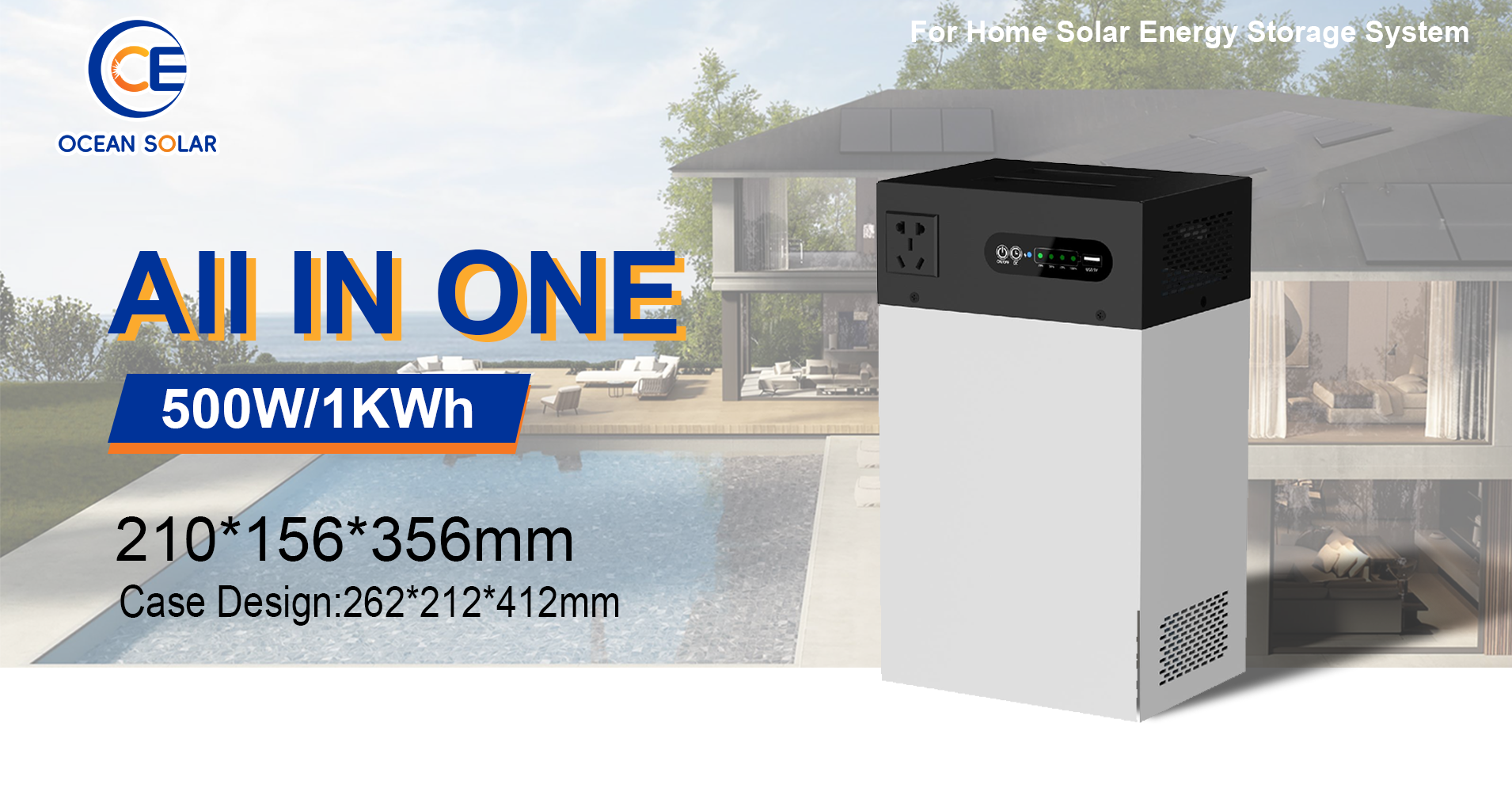
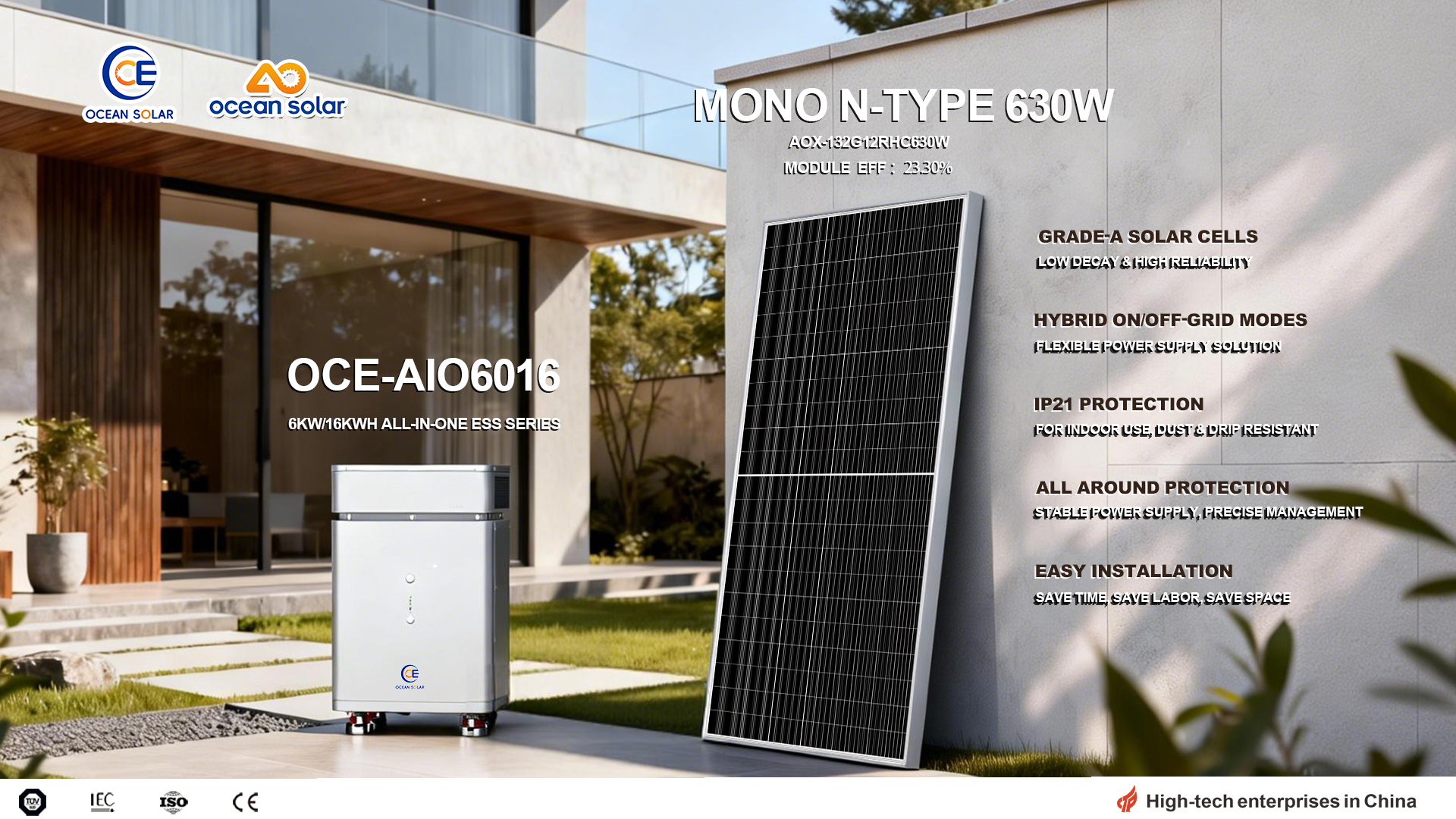
While large enterprises focus on industrial storage, brands specializing in the household sector focus on smaller systems for families. Ocean Solar, for instance, has deeply cultivated the markets in Egypt, Saudi Arabia, and the UAE for years. Their official website, www.oceansolarcn.com, offers a full series of desert-customized all-in-one solar storage systems. These products come standard with IP65-rated battery cabinets, a global intelligent temperature control system, and a smart system, supporting modular expansion from 5kWh to 20kWh. They also offer full local product certifications and an 8-year local cell warranty, making them the preferred choice for small and medium-sized distributors. These products combine reliability and high-quality configurations to meet the budget needs of most households.
1.4.1.2 Complete Certifications for Customs and Grid Connection
Middle Eastern customs and electricity bureaus mandate certifications like IEC62619 (Storage Safety), UN38.3 (Transport), and CB (International Safety). Without these, equipment cannot clear customs or connect to the grid. Quality Chinese lithium battery manufacturers provide full certification sets and multi-language official documents to assist distributors with clearance, significantly reducing trade risks.
1.4.2 Western and Korean Brands: High Cost, Limited Coverage
While international brands like Tesla, LG, and Samsung have rigorous safety standards, their pricing is 40%-70% higher than domestic integrated equipment. They are often split-system designs with poor compatibility with local PV components. Furthermore, they lack official after-sales outlets in second and third-tier Middle Eastern cities, leading to repair wait times of over a month. Consequently, they are rarely purchased by the mass market.
1.4.3 Local Assembly Manufacturers: Low Price, High Risk
Local assemblers in the Middle East lack independent cell production lines, purchasing cheap, off-brand cells. They lack complete thermal optimization designs, leading to capacity degradation of over 40% after just 2 years in temperatures above 40°C. Their simplified BMS systems pose significant safety hazards. While cheap initially, the long-term replacement and repair costs far exceed those of imported integrated units. Families seeking long-term reliability rarely choose local assembly equipment.
·Cell Material: Prioritize original factory LiFePO4 (Lithium Iron Phosphate) cells. The cycle life must be no less than 5500 times (80% DOD). Ternary lithium and lead-acid batteries are unsuitable for the long-term high heat.
·Protection: The battery cabinet must be at least IP65 and feature an active air cooling system. Products lacking these two configurations should be judged as substandard.
·Inverter: The hybrid inverter must standardly feature the EPS millisecond emergency switching function. Without EPS, the system loses its core emergency value during outages. It should also support both on-grid and off-grid modes.
1.6 Future Trends in the Middle East Household Storage Market
1.6.1 Integrated Units Will Dominate
According to MENA storage industry forecasts, the market penetration of household all-in-one solar storage in the Middle East will exceed 65% by 2030. Split systems will shrink due to compatibility and maintenance defects. Manufacturers like Ocean Solar continue to iterate on desert-specific units to better fit local needs.
1.6.2 Lightweight Systems for Urban Apartments
Demand for lightweight 5kWh all-in-one solar storage units is growing rapidly in high-rise apartments where roof space is limited. These compact units reduce volume by 40% and can be installed on balcony walls. Manufacturers are launching compact stackable modules that allow single-person assembly, greatly reducing installation costs for urban families.
1.7 Practical Procurement Advice
1.7.1 Precise Capacity Matching
Before installation, calculate the total daily power consumption of all appliances, adding a 30% buffer for AC load in high-temperature seasons. Apartments should prioritize 5kWh-10kWh wall-mounted units, while villas should pair with 15kWh-25kWh stackable systems.
1.7.2 Avoiding Pitfalls with Suppliers
When cooperating with a lithium battery manufacturer for the first time:
1. Request full official certification documents (IEC, UN38.3).
2. Purchase a sample for a 48-hour continuous charge/discharge simulation test at 50°C to verify thermal control and protection.
1.7.3 One-Stop Procurement is Superior
Purchasing PV panels, inverters, and batteries separately leads to protocol incompatibility and frequent line failures in dusty environments, with multiple parties shirking after-sales responsibility. Choosing a complete all-in-one solar storage system from a single lithium battery manufacturer ensures native protocol adaptation and unified after-sales service, reducing system debugging failure rates by 90% and saving on future maintenance costs.
 English
 العربية
 Русский
 Español
 Português
 Deutsch
 italiano
 日本語
日本語 Nederlands
 Tiếng Việt
 ไทย
ไทย Polski
 Türkçe
 ພາສາລາວ
 ភាសាខ្មែរ
 Bahasa Melayu
 ဗမာစာ
ဗမာစာ தமிழ்
தமிழ் Filipino
 Bahasa Indonesia
 magyar
 Română
 Čeština
 Српски
 हिन्दी
 فارسی
فارسی Slovenčina
 Slovenščina
 Norsk
Norsk Svenska
 українська
 Ελληνικά
 Suomi
Suomi עברית
עברית Dansk
Dansk اردو
اردو বাংলা
বাংলা Hrvatski
 Eesti keel
 සිංහල
සිංහල latviešu
 Azərbaycan dili
 Български
 ગુજરાતી
 ಕನ್ನಡ
ಕನ್ನಡ Kurdî
Kurdî Lietuvių
 മലയാളം
 मराठी
मराठी پښتو
پښتو తెలుగు


 简体中文
简体中文