12V Vs 24V Lithium Battery System: Which Is Better for Solar Power?
You are here: Home » Blog » 12V Vs 24V Lithium Battery System: Which Is Better for Solar Power?
12V Vs 24V Lithium Battery System: Which Is Better for Solar Power?
Views: 0 Author: Site Editor Publish Time: 2026-10-12 Origin: Site
Doubling battery voltage can cut current in half without reducing delivered power. That difference affects cables, heat, voltage drop, and future expansion.
Still, 24V is not automatically better for every solar project. Small loads often favor 12V simplicity, while medium systems benefit from 24V efficiency.
Founded in 2012, Ocean Solar develops solar modules, inverters, lithium batteries, and integrated solar solutions. This guide explains which voltage fits your loads, equipment, and expansion plans.
Understanding a 12V vs 24V Lithium Battery System
Voltage, Current, and Power
A battery system’s voltage describes its electrical pressure. Current measures the electrical flow serving connected loads. Power combines both values through a simple relationship:
Power (W) = Voltage (V) × Current (A)
Suppose an inverter must receive 1,200 watts from its battery bank. Ignoring conversion losses, a 12V bank supplies about 100 amps. A 24V bank supplies about 50 amps.
Both systems deliver the same power. However, the 24V Lithium Battery moves it at half the current. This advantage becomes important as inverter size and cable length increase.
Nominal Voltage Is Not Exact Operating Voltage
A “12V” LiFePO4 battery usually has a 12.8V nominal rating. A 24V LiFePO4 battery commonly has a 25.6V nominal rating. Actual voltage changes across charging and discharging.
Therefore, every component needs a compatible operating range. Match the battery, inverter, charge controller, DC loads, monitoring equipment, and protective devices.
Do not select equipment using the label alone. Review charging voltage, low-voltage cutoff, continuous current, surge current, and BMS limits.
LiFePO4 voltage also stays relatively steady during discharge. Therefore, a simple voltage reading may not show state of charge accurately. Use BMS data or a calibrated battery monitor instead.
Battery Voltage and Panel Voltage Are Different
The solar array does not need the same nominal label as the battery. An MPPT charge controller converts suitable array voltage into the battery’s required charging profile.
Its PV input must stay above the charging voltage during useful sunlight. It must also remain below the controller’s maximum open-circuit voltage during cold weather.
Treat those figures as planning guidance, not universal limits. Inverter surge, cable distance, controller ratings, and future loads can justify another voltage.
Efficiency, Current Draw, Cable Size, and Voltage Drop
Why Lower Current Matters
Cable heating follows the relationship P loss = I²R. Current gets squared, while conductor resistance remains fixed. This makes high current expensive to manage.
At equal power, a 24V system draws approximately half the current of 12V. Using the same cable, theoretical resistive loss falls to about one quarter.
Real installations may use smaller 24V conductors instead. Final savings depend on cable length, insulation rating, ambient temperature, bundling, and allowable voltage drop.
A 1,200W Load Example
The comparison below ignores inverter losses for clarity. Actual current will be slightly higher because no inverter is perfectly efficient.
Factor
12V Battery Bank
24V Battery Bank
Load power
1,200W
1,200W
Approximate current
100A
50A
Current-related heating
Higher
Lower
Voltage drop risk
Higher
Lower
Typical cable requirement
Heavier
Lighter for equal conditions
Native DC accessory range
Very broad
More limited
A lower current can reduce heat around terminals, breakers, fuses, and busbars. It also makes longer battery-to-inverter runs easier to engineer.
However, smaller cable is never an automatic choice. Size conductors using maximum continuous current, surge duration, run length, installation method, and local electrical rules.
Efficiency Does Not Come Only From Battery Voltage
A 24V Lithium Battery cannot repair poor system design. Long cable runs, loose terminals, undersized conductors, weak crimping, and mismatched equipment still waste energy.
Keep the battery and inverter close whenever safe and practical. Protect each positive conductor near its energy source. Use rated disconnects, overcurrent protection, and properly torqued connections.
Capacity, Charging, and Battery Bank Configuration
Compare Watt-Hours, Not Amp-Hours Alone
Amp-hour ratings become misleading across different voltages. A 12V 100Ah battery and a 24V 100Ah battery do not store equal energy.
Use this calculation:
Nominal energy (Wh) = Nominal voltage (V) × Capacity (Ah)
A 12.8V 100Ah LiFePO4 battery stores about 1,280Wh. A 25.6V 100Ah 24V Lithium Battery stores about 2,560Wh.
Two matched 12.8V 100Ah batteries connected in series also create 25.6V and 100Ah. Their combined energy remains about 2,560Wh.
Usable energy will be lower than the nominal figure. Apply the approved depth of discharge, temperature limits, conversion efficiency, and BMS reserve when estimating realistic runtime.
One 24V Battery or Two 12V Batteries?
A purpose-built 24V battery usually offers simpler cabling and one integrated BMS. Two series-connected 12V batteries may offer easier sourcing or replacement.
Series operation is only safe when the manufacturer permits it. Batteries should share the same model, capacity, age, state of charge, and firmware requirements.
Never place unmatched batteries in series. One battery may reach a protection limit before the other, causing shutdowns or uneven charging.
Ocean Solar treats voltage selection as part of complete system design, not a standalone battery purchase. The battery, BMS, inverter, charging profile, and communications must work as one system.
Charge Controller and Solar Array Requirements
A controller’s advertised amperage supports more charging power at 24V. For example, a 40A controller can deliver roughly twice the battery-side wattage at 24V versus 12V.
That does not mean every 40A controller accepts any array. Verify maximum PV voltage, maximum PV power, input current, charging current, and approved battery chemistry.
Set the lithium charging profile from the battery datasheet. Avoid generic lead-acid equalization settings because they can trigger BMS protection or damage cells.
Also confirm low-temperature charging rules. Many LiFePO4 batteries require charging protection near freezing, even when discharge remains available.
When 12V Is Better and When 24V Is Better
Choose 12V for Small, Accessory-Heavy Systems
A 12V lithium battery system suits compact solar installations using modest loads. Common examples include small campers, boats, lighting systems, communications equipment, and portable backup power.
Many automotive and marine accessories already operate at 12V. Direct compatibility reduces converters, extra wiring, standby loss, and possible failure points.
Choose 12V when most conditions below apply:
The inverter and solar array are relatively small.
Battery-to-inverter cables are short and correctly sized.
Most DC appliances require native 12V power.
Expansion beyond the current load plan is unlikely.
Local replacement parts favor 12V equipment.
High-power 12V systems remain possible, but current rises quickly. A 2,000W inverter may demand around 167A before accounting for efficiency and surge loads.
Choose 24V for Medium Solar Power Systems
A 24V Lithium Battery is often better for cabins, larger RVs, work vehicles, small workshops, and medium off-grid solar systems. It handles higher inverter power using less DC current.
This reduces voltage drop and may lower conductor, busbar, fuse, and switchgear demands. It also gives many charge controllers more usable solar wattage at the same output-current rating.
Choose 24V when several conditions below apply:
The system commonly powers loads near or above 1,000W.
Cable runs are longer or voltage drop is difficult to control.
The solar array may grow after the first installation.
Most major components are available in compatible 24V versions.
Lower current is more valuable than direct 12V accessory support.
Remember the 48V Alternative
Large home systems can outgrow both choices. A 24V system supplying 4,000W still draws about 167A before losses.
That current can require heavy conductors and robust protection. For high-capacity homes or commercial loads, a 48V-class battery system may provide a stronger path.
System voltage should follow peak demand, not battery marketing. Calculate simultaneous loads, motor starting surges, daily energy, autonomy, and expected expansion first.
How to Choose and Build the Right Solar Battery System
Start With Loads and Runtime
List every appliance, its running watts, starting surge, and daily operating hours. Add daily watt-hours, then decide how many hours or days the battery should support.
Estimate usable capacity after depth of discharge and inverter efficiency:
Required nominal energy = Daily load ÷ Usable DoD ÷ System efficiency
Battery voltage changes current, but it does not change the energy your loads consume. A poorly sized 24V bank can still provide disappointing runtime.
Use worst-season solar production when planning an off-grid system. Include cloudy-day autonomy, overnight loads, inverter standby use, and battery heating or cooling. Then add a reasonable reserve for changing demand.
Check the Complete Compatibility Chain
Before buying a 24V Lithium Battery, confirm these items together:
1. Battery: nominal energy, operating voltage, BMS current, surge limit, series or parallel permissions.
5. DC loads: native 24V support or a properly sized 24V-to-12V converter.
Never connect a 12V appliance directly across part of a 24V series bank. This creates imbalance and can overwork one battery.
Plan Expansion Before Installation
Expansion is easier when the original inverter, controller, busbars, enclosure, and protection devices allow it. Check manufacturer limits before adding batteries later.
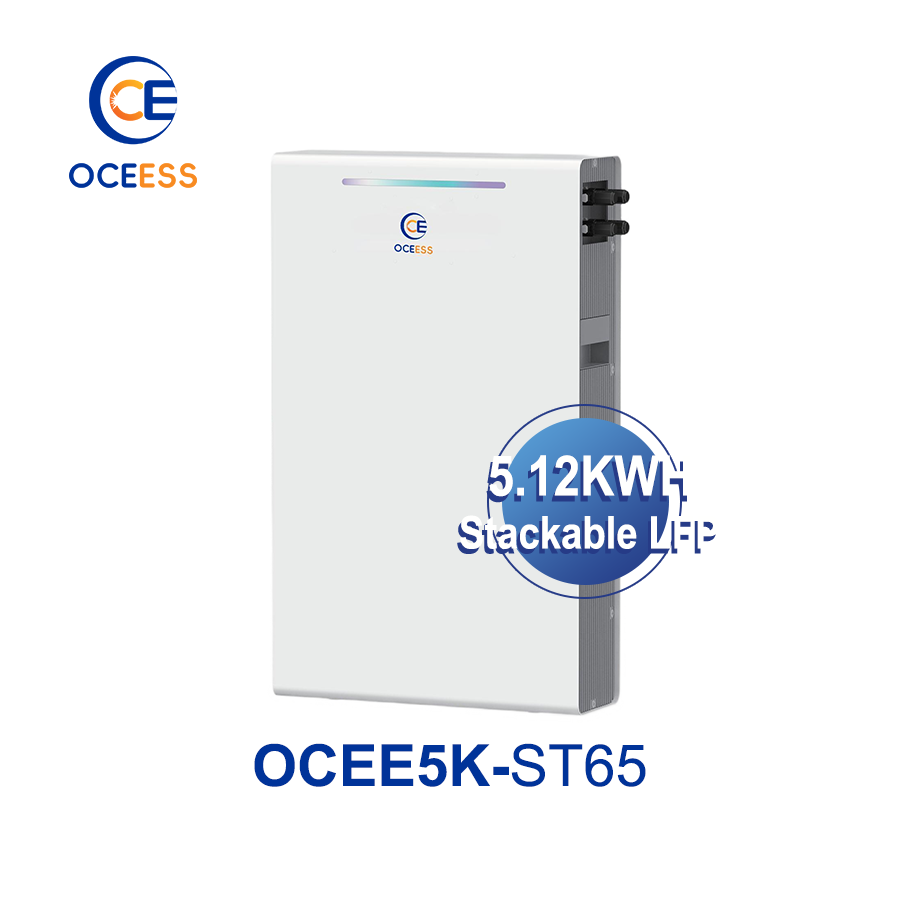
Ocean Solar’s 5.12kWh stackable LFP battery illustrates another scaling path. It uses a 51.2V, 100Ah platform, intelligent BMS, CAN/RS485 communication, and parallel expansion.
That product is a 48V-class solution, not a 24V model. It shows why larger residential storage projects often move beyond 24V.
Request the current datasheet before specifying any battery. Confirm voltage range, charging parameters, inverter protocols, certifications, warranty terms, and approved expansion arrangements.
Conclusion
Choose 12V for small systems using short cables and many native 12V loads. Choose 24V for medium systems needing lower current, easier expansion, and reduced voltage drop.
Neither voltage replaces proper engineering. Match every component, calculate surge current, and size protection from verified datasheets.
For larger residential loads, compare 24V against 48V before purchasing equipment.
FAQs About 12V and 24V Lithium Battery Systems
Q: Is a 24V Lithium Battery better than a 12V battery for solar?
A: It is usually better for medium-power systems because it supplies equal power at roughly half the current. That can reduce voltage drop, conductor size, and heat. However, 12V remains simpler for small installations using many 12V accessories. Choose after comparing load power, cable length, inverter voltage, controller limits, and future expansion.
Q: Can two 12V lithium batteries create a 24V battery bank?
A: Yes, two matched 12.8V batteries connected in series can create a 25.6V nominal bank. The manufacturer must approve series operation. Use identical batteries sharing model, capacity, age, charge level, and recommended settings. Do not mix brands, chemistries, capacities, or old and new batteries.
Q: Can a 24V solar panel charge a 12V lithium battery?
A: The panel does not charge the battery directly. A compatible MPPT charge controller converts suitable PV voltage into the battery’s required charging profile. Verify the controller’s PV voltage, open-circuit limit, input current, output current, and lithium settings. Never connect a higher-voltage panel directly to the battery.
Q: Can 12V appliances run from a 24V Lithium Battery?
A: Yes, but they normally require a properly sized 24V-to-12V DC-DC converter. Include startup surge, continuous current, conversion efficiency, and fuse protection when sizing it. Never tap one battery inside a two-battery series bank because unequal loading can create imbalance.
Q: Does a 24V battery last longer than a 12V battery?
A: Voltage alone does not determine runtime or cycle life. Compare stored watt-hours, usable depth of discharge, load efficiency, temperature, charging settings, and cell quality. At equal usable energy and equal load, runtime can be similar. A well-designed 24V system may waste less energy through high-current wiring.
Q: What inverter should I use for a 24V battery bank?
A: Use an inverter designed for the battery’s full operating-voltage range. Check continuous output, surge power, efficiency, idle consumption, low-voltage cutoff, charger settings, and BMS compatibility. Its continuous DC demand must remain below the battery bank’s approved discharge-current limit.
Q: Is 24V enough for a whole-house solar system?
A: It may suit a small cabin or limited-load home, but larger houses often benefit from 48V-class storage. At 4,000W, a 24V bank can draw about 167A before conversion losses. Review simultaneous loads, surge demand, cable distance, array size, and expansion plans before deciding.
 English
 العربية
 Русский
 Español
 Português
 Deutsch
 italiano
 日本語
 Nederlands
 Tiếng Việt
 ไทย
 Polski
 Türkçe
 ພາສາລາວ
 ភាសាខ្មែរ
 Bahasa Melayu
 ဗမာစာ
 தமிழ்
 Filipino
 Bahasa Indonesia
 magyar
 Română
 Čeština
 Српски
 हिन्दी
 فارسی
 Slovenčina
 Slovenščina
 Norsk
 Svenska
 українська
 Ελληνικά
 Suomi
 עברית
 Dansk
 اردو
 বাংলা
 Hrvatski
 Eesti keel
 සිංහල
 latviešu
 Azərbaycan dili
 Български
 ગુજરાતી
 ಕನ್ನಡ
 Kurdî
 Lietuvių
 മലയാളം
 मराठी
 پښتو
 తెలుగు


 简体中文