


 简体中文


|


144M10RHC 450W-475W
Ocean Solar
N-type TOPCon Technology, Half-cut cells
1762m x 1134mm x 30 mm
962pcs/40HQ Container
23Kg
30years
Product Description
Ocean Solar AOX-144M10RHC is a 450W-475W N-type TOPCon bifacial dual-glass solar panel designed for residential, commercial, industrial and distributed photovoltaic projects requiring high front-side power density together with additional rear-side energy generation.
The series combines 144 N-type TOPCon half-cut cells with SMBB interconnection technology and delivers up to 475W front-side rated power with module efficiency up to 23.80%. Its compact 1762 × 1134 × 30mm format is suitable for projects where available installation area and installed DC capacity must be balanced.
Published bifaciality reaches up to 85±5%, allowing reflected irradiance reaching the rear cell surface to contribute additional energy. The module also features a dual-glass structure, -0.29%/°C Pmax temperature coefficient, 1500VDC maximum system voltage, IP68 junction box and 5400Pa / 2400Pa mechanical-load ratings.


| Parameter | Specification |
| Module Model | AOX-144M10RHC |
| Power Range | 450W-475W |
| Maximum Front-Side Efficiency | 23.80% |
| Cell Technology | N-Type TOPCon Half-Cut Cells |
| Number of Cells | 144 |
| Module Design | Bifacial Dual Glass |
| Bifaciality | Up to 85±5% |
| Dimensions | 1762 × 1134 × 30mm |
| Weight | Approx. 23kg |
| Front Glass | 2.0mm High-Transmission AR-Coated Tempered Glass |
| Rear Glass | 2.0mm Heat-Strengthened Glass |
| Encapsulation | EVA |
| Frame | 30mm Anodized Aluminium Alloy |
| Junction Box | IP68 Rated, 3 Bypass Diodes |
| Cable | 1 × 4mm², 350mm or Customized |
| Connector | MC4 / MC4 Compatible |
| Maximum System Voltage | 1500VDC (IEC) |
| Maximum Series Fuse | 30A |
| Power Output Tolerance | 0 to +5W |
| Voc and Isc Tolerance | ±3% |
| Operating Temperature | -40°C to +85°C |
| NOCT | 45±2°C |
| Pmax Temperature Coefficient | -0.29%/°C |
| Voc Temperature Coefficient | -0.25%/°C |
| Isc Temperature Coefficient | +0.045%/°C |
| Front Mechanical Load | 5400Pa / 550kg/m² |
| Rear Mechanical Load | 2400Pa / 244kg/m² |
| Hail Resistance | Maximum Ø25mm at 23m/s |
| Protection Class | Class II |
| Fire Rating | UL Type 1 or 2 / IEC Class C |
| Packaging | Approx. 962pcs / 40HQ Container |
| Product Warranty | 12-Year Materials and Processing Warranty |
| Linear Power Warranty | 30-Year Extra Linear Power Output Warranty |
The AOX-144M10RHC is designed to generate electricity from irradiance reaching both the front and rear cell surfaces. Published bifaciality reaches up to 85±5%, providing an opportunity to increase total energy generation when the rear side receives sufficient reflected sunlight.
Bifaciality and actual bifacial energy gain are different parameters. Bifaciality describes the relative rear-side electrical response of the module, while real project energy gain depends on the amount of irradiance that actually reaches the rear surface.
Ground or roof reflectivity, mounting height, row spacing, tilt angle, structural shading and cable routing can all influence rear-side irradiance. Projects should therefore model bifacial performance using site-specific conditions rather than applying a fixed energy-gain percentage.
Discuss Your Bifacial PV Project
The following published front-side ratings are specified under Standard Test Conditions with 1000W/m² irradiance, 25°C cell temperature and AM1.5 spectrum. The latest approved module datasheet should be used when completing final inverter and string calculations.
| Parameter | 450W | 455W | 460W | 465W | 470W | 475W |
| Pmax | 450W | 455W | 460W | 465W | 470W | 475W |
| Vmp | 30.05V | 30.30V | 30.55V | 30.80V | 31.05V | 31.30V |
| Imp | 14.76A | 15.02A | 15.06A | 15.10A | 15.14A | 15.18A |
| Voc | 30.75V | 31.00V | 31.25V | 31.50V | 31.75V | 32.00V |
| Isc | 15.74A | 15.79A | 15.84A | 15.89A | 15.94A | 15.99A |
| Front-Side Efficiency | 22.50% | 22.80% | 23.00% | 23.30% | 23.50% | 23.80% |
| NOCT Pmax | 335W | 339W | 343W | 347W | 351W | 355W |
The published product data provides illustrative output values for 5% and 10% rear-side irradiation scenarios. These figures demonstrate how rear-side irradiance can increase instantaneous module output under the stated assumptions.
These examples should not be interpreted as guaranteed annual bifacial gain. Actual field performance depends on the installation environment and project design.
| Front-Side Rated Power | 450W | 455W | 460W | 465W | 470W | 475W |
| 5% Rear-Side Gain Scenario | 473W | 478W | 483W | 488W | 494W | 499W |
| 10% Rear-Side Gain Scenario | 495W | 500W | 506W | 512W | 517W | 523W |
The AOX-144M10RHC uses N-type TOPCon half-cut cells combined with SMBB interconnection technology. TOPCon passivated-contact architecture is designed to reduce carrier recombination losses and support high photovoltaic conversion efficiency.
N-type cell architecture also supports bifacial photovoltaic designs because irradiance reaching the rear cell surface can participate in energy conversion.
Half-cut cell design and multiple busbar current paths support electrical collection across the module while helping manage current within individual cell sections.
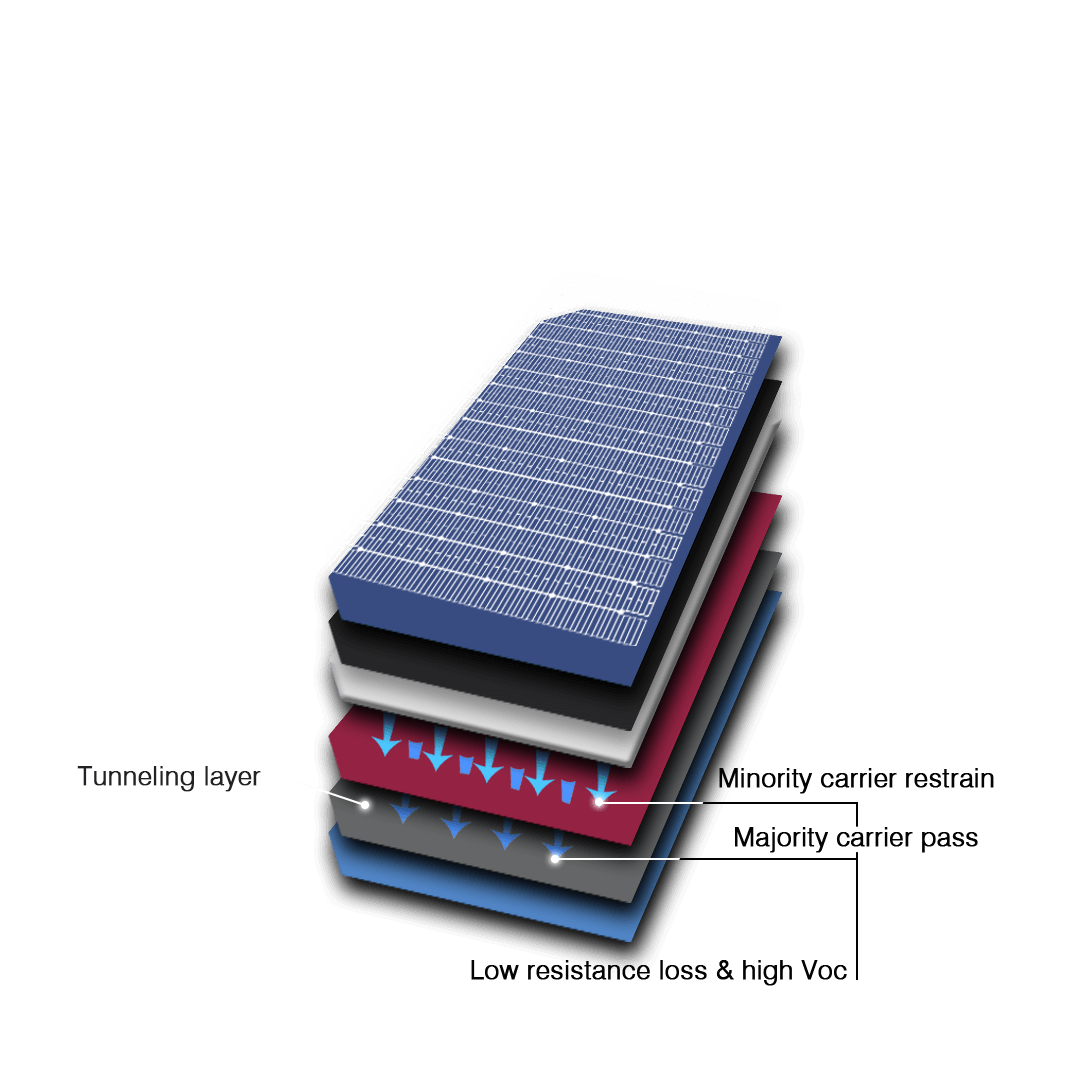
The AOX-144M10RHC combines 2.0mm high-transmission AR-coated tempered front glass with 2.0mm heat-strengthened rear glass. The rear-side structure allows reflected irradiance to reach the bifacial solar cells while providing glass protection on both sides of the laminate.
The module also uses EVA encapsulation, a 30mm anodized aluminium-alloy frame, an IP68-rated junction box with three bypass diodes and 4mm² photovoltaic cable.
MC4 or compatible connectors are specified, while the standard cable length is approximately 350mm. Customized cable length can be discussed for project requirements.
The highest-power version delivers 475W of front-side rated output within a compact 1762 × 1134mm footprint and reaches up to 23.80% front-side module efficiency.
This size is particularly relevant to residential and commercial rooftops where usable installation area is limited and installers need to balance module handling, array layout and installed DC capacity.
On installations with sufficient rear-side exposure, bifacial operation can add energy beyond the front-side rated output without increasing the physical module footprint.
The published Pmax temperature coefficient is -0.29%/°C. This parameter is important because photovoltaic cell temperature commonly rises above the 25°C Standard Test Condition reference during normal outdoor operation.
The Voc temperature coefficient is -0.25%/°C and the Isc temperature coefficient is +0.045%/°C.
These values should be considered when evaluating hot-weather output and calculating maximum string open-circuit voltage under low-temperature conditions.
The module is specified for a maximum front-side mechanical test load of 5400Pa. Final structural suitability depends on mounting configuration, clamp location, supporting structure and project-specific load calculations.
The published rear-side mechanical test load is 2400Pa. Racking, rails, clamps and mounting hardware should be selected according to the module installation requirements and local wind conditions.
The current product specification lists resistance to hailstones up to 25mm in diameter at an impact velocity of 23m/s.
The AOX-144M10RHC supports a maximum system voltage of 1500VDC under the stated IEC specification and has a maximum series fuse rating of 30A.
Final modules-per-string calculations should consider module Voc, minimum project temperature, Voc temperature coefficient, inverter maximum DC voltage and MPPT operating-voltage range.
Module operating current and short-circuit current should also be checked against the selected inverter's MPPT input-current and short-circuit-current limits before finalizing system design.
Commercial and industrial rooftops can use the high front-side power density to increase installed DC capacity within available roof space. Bifacial energy contribution can be evaluated when roof surfaces and mounting geometry provide useful reflected irradiance to the rear side.
Elevated carport and canopy structures can provide favorable rear-side exposure because reflected light can reach the back of the module more easily than on tightly mounted rooftop systems.
Ground-mounted photovoltaic arrays can benefit from bifacial generation when mounting height, row spacing, tilt and ground reflectivity are considered during system design.
The compact 1762 × 1134mm format is also relevant to residential systems where available roof area is limited. Rear-side energy gain may be relatively small on flush-mounted dark roofs and higher where sufficient rear clearance and reflected irradiance are available.


Bifacial performance depends primarily on the amount of irradiance reaching the rear surface. Light-colored and reflective surfaces generally provide more useful rear-side irradiance than dark, low-reflectance surfaces.
Increasing clearance between the rear module surface and the roof or ground can improve rear-side light exposure. Row spacing, tilt angle, mounting rails, structural members and cable routing should also be designed to reduce rear-side shading.
For ground-mounted and commercial projects, expected rear-side energy contribution should be modeled using site irradiance, surface albedo, module height, row spacing and array geometry rather than relying on a fixed percentage.
A bifacial module is most useful when the installation allows reflected irradiance to reach the rear surface. Elevated ground systems, carports, canopies and installations over reflective surfaces can provide favorable conditions.
On a dark roof where the module is installed close to the mounting surface and rear irradiance is heavily restricted, additional bifacial energy may be limited. In those projects, module price, front-side efficiency, weight and installation requirements should be compared with a monofacial alternative.
Ask Which Module Fits Your Project
The AOX-144M10RHC specification provides a 12-year warranty for materials and processing together with a 30-year extra linear power output warranty.
The published warranty profile states an average annual power decline of no more than 0.4% from the second through the thirtieth year.
Product warranty and linear power output warranty are separate terms. Detailed coverage, exclusions and claim conditions remain subject to the applicable written warranty documentation.
Production of dual-glass bifacial modules includes photovoltaic cell interconnection, automatic cell-string layup, bussing, EL electroluminescence inspection, lamination, frame installation, visual inspection, electrical performance testing and final EL inspection before packaging.

SMBB PV cell soldering
Automatic PV cell-string layup
Automatic bussing
PV cell-string positioning
EL electroluminescence testing
Automatic edge sealing
Solar module lamination
Automatic edge trimming
Visual inspection
Automatic frame installation
Automatic glue dispensing
Silicone curing
Visual inspection and cleaning
Power testing
Final EL testing
Packaging
The standard product specification lists approximately 962 AOX-144M10RHC modules per 40HQ container.
Final pallet configuration, container loading quantity, delivery schedule, destination documentation and shipment terms should be confirmed with the commercial quotation before ordering.


Ocean Solar supports cooperation with photovoltaic distributors, importers, EPC contractors and solar brands.
Project requirements can include product labels, packaging, cable length, connector selection and other agreed product details subject to technical confirmation.
Any change involving cell layout, module dimensions, electrical characteristics, glass structure or module construction should be evaluated as a separate customized configuration and supported by the corresponding product documentation.
Discuss OEM & Project Requirements
 Download 450W-475W Bifacial Dual-Glass Solar Panel Datasheet
The series includes 450W, 455W, 460W, 465W, 470W and 475W front-side rated power classes.
The 475W version has a published front-side module efficiency of up to 23.80%.
The published bifaciality is up to 85±5%. This describes rear-side electrical response relative to the front side and is not the same as the percentage of additional annual energy generated at a project site.
The published data provides illustrative 5% and 10% rear-side irradiation scenarios. For the 475W model, these correspond to approximately 499W and 523W respectively under the stated assumptions. Actual field performance varies by installation.
Rear-side generation depends on surface reflectivity, module mounting height, tilt angle, row spacing, structural shading, cable routing and the amount of irradiance reaching the rear module surface.
The AOX-144M10RHC uses 144 N-type TOPCon half-cut solar cells together with SMBB interconnection technology.
The module measures 1762 × 1134 × 30mm and weighs approximately 23kg.
The published Pmax temperature coefficient is -0.29%/°C. The Voc coefficient is -0.25%/°C and the Isc coefficient is +0.045%/°C.
The maximum system voltage is 1500VDC under the stated IEC specification, and the maximum series fuse rating is 30A.
The module is specified for up to 5400Pa front-side and 2400Pa rear-side mechanical test loads when installed according to the applicable mounting configuration.
Yes. The product specification lists an IP68-rated junction box with three bypass diodes.
Not necessarily. A bifacial module provides the greatest benefit when sufficient irradiance reaches the rear side. Where the rear surface is almost completely blocked or receives little reflected light, the additional energy benefit may be limited.
They can be suitable when the mounting system provides sufficient rear clearance and the roof surface reflects useful irradiance. Roof color, module height and racking design should be considered when estimating rear-side contribution.
Elevated carport and canopy installations can provide useful rear-side exposure because reflected irradiance can reach the back of the module. Actual performance depends on the structure and surrounding surfaces.
The AOX-144M10RHC specification lists a 12-year warranty for materials and processing together with a 30-year extra linear power output warranty.
The current packaging specification lists approximately 962 modules per 40HQ container. Final pallet and loading quantities should be reconfirmed when placing an order.
Distributors, importers and OEM buyers can discuss product labeling, packaging, cable length, connector selection and other agreed project requirements before production.
Please provide the required power class, project quantity, destination country, installation type, inverter model, planned string design, roof or ground surface, expected rear-side exposure and any documentation or OEM requirements.


