1. 2026 Industry Inflection Point: Multiple Reforms Reshape China’s Solar Panel Track
1.1 Intensive Domestic Policies End the Industry’s Low-Price Involution Era
1.1.1 Cancellation of Export Tax Rebates in April 2026 Restructures the Foreign Trade Pricing System
1.1.1.1 Core Policy Content and Short-Term Industry Impacts
1.1.1.1.1 Full Industrial Chain Export Dividends Completely Disappear
According to the latest announcements from China’s Ministry of Finance and State Taxation Administration, the value-added tax (VAT) export rebates for all photovoltaic products including solar panels, solar cells, and silicon wafers have been officially canceled starting from April 1, 2026. The long-standing foreign trade subsidy dividends have come to a complete end. This landmark policy thoroughly breaks the industry’s profit model relying on low-volume and low-price exports, eliminating a large number of small and medium-sized manufacturers that survive on tax rebate arbitrage and inferior product quality. In the short term, the overall export quotations of China’s solar panels have risen slightly, stripping low-quality and low-cost products of their price advantages. In the long run, it drives China’s solar panel industry to shift from “scale expansion” to “quality-oriented development”, laying a solid policy foundation for the high-quality development of the industry from 2026 to 2030.
1.1.1.2 Forcing Enterprises to Optimize Product Structure and Profit Model
After the cancellation of export tax rebates, homogeneous low-price competition is no longer viable in the market. Leading domestic photovoltaic enterprises have gradually phased out inefficient production capacity and increased investment in the R&D and production of high-efficiency N-type modules and customized photovoltaic products. From 2026 to 2030, low-power, high-attenuation, and technologically backward solar panels will gradually withdraw from the foreign trade market, while high-efficiency, high weather resistance, and highly customized premium modules will become the mainstream export standard, completely reshaping the product landscape of China’s photovoltaic foreign trade business.
1.1.2 MIIT Anti-Involution Regulation Standardizes the Entire Industrial Chain Competition Order
1.1.2.1 Joint Rectification of Disordered Capacity Expansion by Multiple Departments
In April 2026, four major Chinese government departments including the Ministry of Industry and Information Technology (MIIT) and the National Development and Reform Commission (NDRC) jointly held a high-quality development symposium for the photovoltaic industry. The meeting clarified four core rectification measures: capacity regulation, standard upgrading, merger and reorganization, and quality supervision to curb industrial involution. Strict regulatory rules have been issued to solve persistent industry problems such as overcapacity, predatory low-price dumping, and false power labeling, banning malicious low-price bidding and inferior product exports. This means China’s solar panel industry will enter a standardized and refined supervision cycle from 2026 to 2030, with continuous growth in industry concentration.
1.1.2.2 New Grid-Connection Policies Promote the Precipitation of High-Quality Production Capacity
The revised distributed photovoltaic grid-connection management measures, to be implemented in June 2026, adopt a flexible green-yellow-red zoning management mode, replacing the traditional rigid capacity limit mechanism. Compliant, high-quality, and stable-performance solar panels can achieve rapid grid connection, while non-standard inferior products are completely restricted from market access. This further forces manufacturers to focus on product quality optimization, creating a high-quality industrial environment for overseas buyers to select reliable solar panel suppliers.
1.2 Trump’s Visit to China Reshapes China-EU-US Photovoltaic Foreign Trade Cooperation Pattern
1.2.1 Gradual Relaxation of Sino-US Photovoltaic Trade Barriers
During Trump’s visit to China in May 2026, China and the United States reached multiple consensus on new energy foreign trade cooperation. In-depth consultations were conducted on photovoltaic tariff barriers, trade frictions, and market access issues, releasing positive signals for easing Sino-US photovoltaic trade confrontation. The previous stringent unilateral tariff restrictions and market access thresholds are expected to be gradually relaxed, opening up channels for Chinese solar panels to re-enter and further penetrate the mainstream European and American markets.
1.2.2 Foreign Trade Rules Become More Transparent and Standardized
This diplomatic negotiation has clarified the compliance standards, quality inspection specifications, and tariff mechanisms for cross-border photovoltaic trade in the next stage, eliminating disorderly trade and malicious trade barriers. From 2026 to 2030, China’s solar panel exports will abandon the extensive bulk sales model and shift to compliant, branded, and high-quality exports. The overseas market competition will no longer focus on low prices, but on product quality, professional services, and compliance capabilities.
2. Five Core Development Trends of China’s Solar Panels (2026-2030)
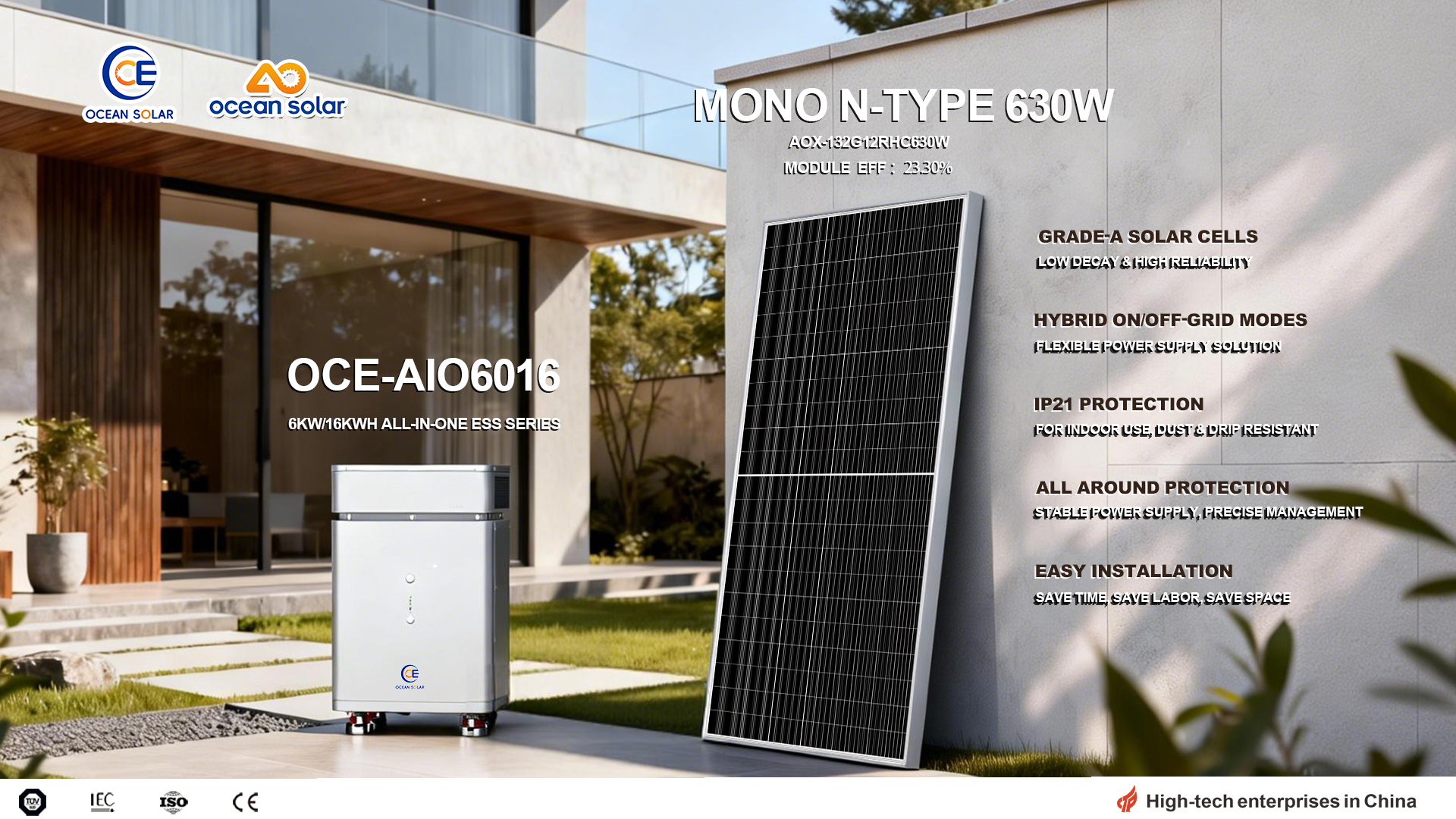
2026 marks the first year of the comprehensive popularization of N-type photovoltaic technology. In the next five years, new-generation high-efficiency battery technologies including N-TOPCon and HJT will completely replace traditional P-type modules and become the absolute mainstream technical route for China’s photovoltaic exports. With industrial capacity restructuring and quality upgrading, outdated low-efficiency, high-attenuation P-type modules are gradually phased out of foreign trade circulation, while high-conversion, strong weather-resistant, low-temperature-coefficient N-TOPCon solar panels have become the standard for global photovoltaic projects. Among mainstream brands, Ocean Solar focuses on self-developed and mass-produced N-TOPCon high-efficiency solar panels. It has deployed new-generation technical capacity in advance, with products featuring high conversion efficiency, excellent high-temperature attenuation resistance, and superior low-light power generation performance. Fully aligned with the 2026-2030 industrial technology iteration trends, Ocean Solar has become a preferred cost-effective N-type module brand for bulk procurement by small and medium-sized overseas buyers. The overall mass production efficiency of China’s photovoltaic modules will continue to climb, exceeding 26%, with comprehensive upgrades in core outdoor performances such as high-temperature resistance, dust resistance, and anti-microcrack capability, completing the full technical upgrade of China’s solar panel products.
2.2 Product Form Trend: Explosive Growth in Demand for Custom Solar Panels
With the growing global demand for distributed photovoltaics, building-integrated photovoltaics (BIPV), and diversified niche installation scenarios, standard universal modules can no longer adapt to complex overseas application environments. From 2026 to 2030, customized solar panels with adjustable glass thickness, diverse frame materials, non-standard sizes, and personalized appearances will become a new growth point of photovoltaic foreign trade. Brands with flexible customized production capacity will continue to capture high-end overseas market shares. In this field, Ocean Solar stands out with flexible customized production lines and product optimization tailored for harsh overseas working conditions, making it a popular emerging brand among small and medium-sized overseas photovoltaic buyers in recent years.
2.3 Industrial Pattern Trend: Capacity Phase-Out and Sharply Increased Industry Concentration
Driven by the cancellation of export tax rebates, anti-involution regulation, and comprehensive quality upgrading, inefficient small and medium-sized domestic capacities are being phased out at an accelerated pace. Industrial resources are continuously concentrated on formal leading enterprises and quality-oriented manufacturers. In the next five years, China’s solar panel export market will bid farewell to the mixed-quality disorderly state, with more stable product quality and a clearer brand system, greatly reducing the product selection risks for overseas procurement merchants.
2.4 Foreign Trade Model Trend: Transformation from Low-Price Bulk Sales to Brand-Based Value Exports
Benefiting from policy regulation and optimized foreign trade environment, China’s photovoltaic export industry has completely abandoned the outdated model of low-price involution and small-profit bulk sales. It has transformed into high-value, service-oriented branded exports. Domestic manufacturers pay more attention to localized overseas services, after-sales guarantee, and international compliance certification, no longer relying solely on price competition. Long-term cooperative relationships and stable delivery capacity have become the core competitiveness of photovoltaic foreign trade business.
2.5 Green Compliance Trend: Full-Link Low-Carbon Upgrade to Adapt to Global Dual-Carbon Standards
Countries worldwide have successively launched carbon footprint and green market access standards for photovoltaic products. From 2026 to 2030, low-carbon production, green manufacturing, and recyclable design will become mandatory thresholds for China’s solar panel exports. Only products with complete carbon footprint reports and full certifications including EU CE, IEC, and UL can smoothly enter high-end markets in Europe, America, the Middle East, and Southeast Asia.
3. Practical Procurement Suggestions for Overseas Solar Panel Buyers Under the New Pattern
3.1 Product Selection: Abandon Low-Price Prejudice and Prioritize Compliant High-Quality Supplies
After the cancellation of export tax rebates, ultra-low-price products are inevitably accompanied by reduced quality, missing certifications, and high attenuation rates. Procuring inferior modules will easily lead to grid connection failures, after-sales disputes, and project losses. Overseas buyers are advised to prioritize formal manufacturers with complete qualifications, mass-produced high-efficiency N-type modules, and mature quality control systems, and select high weather resistance, low attenuation solar panels adapted to local climates to ensure long-term stable project returns.
The industrial reshuffle will accelerate from 2026 to 2030, with a large number of small and medium-sized manufacturers exiting the market and leaving no reliable after-sales support. Buyers are recommended to prioritize reputable brands such as Ocean Solar, which specializes in high-quality N-TOPCon solar panels, provides flexible customization services, ensures stable delivery, and maintains a comprehensive global after-sales system. It can meet both standardized bulk procurement and non-standard customized project demands, balancing cost performance and long-term operational stability, and effectively avoiding supply interruption and after-sales vacancy risks caused by industrial capacity elimination.
3.3 Procurement Rhythm: Lock Prices and Stock Up in Advance to Avoid Price Fluctuation Risks
Affected by policy adjustments, capacity elimination, and raw material price fluctuations, the continuous price decline of solar panels has ended, and market prices will gradually stabilize and rise moderately in the future. Overseas buyers are advised to abandon temporary sporadic procurement modes, plan orders in advance, and lock prices for bulk stock preparation to effectively avoid price fluctuation and capacity shortage risks, and maximize procurement profit margins.
3.4 Compliance Layout: Adapt to the Latest Market Access Standards Worldwide in Advance
With the easing of Sino-US trade relations and the upgrading of global photovoltaic compliance requirements, market access standards in various countries continue to tighten. Buyers need to cooperate with suppliers with complete international certifications, official carbon footprint reports, and compliant customs declaration qualifications to avoid tariff barriers, access failures, and grid acceptance problems, ensuring smooth project implementation.
4. Conclusion: China’s Photovoltaic Foreign Trade Usher in a High-Quality New Cycle (2026-2030)
As a pivotal year for industrial transformation, 2026 witnesses three major reforms — the cancellation of photovoltaic export tax rebates, the implementation of anti-involution policies, and the easing of Sino-US photovoltaic trade — which completely end the extensive development era of China’s solar panel industry. From 2026 to 2030, the industry will achieve continuous breakthroughs in four core directions: efficient technological iteration, customized product upgrading, compliant brand globalization, and green low-carbon transformation, transforming China from a photovoltaic manufacturing powerhouse to a high-quality photovoltaic power country. For overseas buyers, the industrial reshuffle brings both challenges and opportunities. Abandoning low-price involution thinking, focusing on product quality and compliance, and cooperating with stable high-quality suppliers will help fully capture the development dividends of China’s high-quality photovoltaic industry and achieve long-term win-win cross-border photovoltaic cooperation.
 English
 العربية
 Русский
 Español
 Português
 Deutsch
 italiano
 日本語
日本語 Nederlands
 Tiếng Việt
 ไทย
ไทย Polski
 Türkçe
 ພາສາລາວ
 ភាសាខ្មែរ
 Bahasa Melayu
 ဗမာစာ
ဗမာစာ தமிழ்
தமிழ் Filipino
 Bahasa Indonesia
 magyar
 Română
 Čeština
 Српски
 हिन्दी
 فارسی
فارسی Slovenčina
 Slovenščina
 Norsk
Norsk Svenska
 українська
 Ελληνικά
 Suomi
Suomi עברית
עברית Dansk
Dansk اردو
اردو বাংলা
বাংলা Hrvatski
 Eesti keel
 සිංහල
සිංහල latviešu
 Azərbaycan dili
 Български
 ગુજરાતી
 ಕನ್ನಡ
ಕನ್ನಡ Kurdî
Kurdî Lietuvių
 മലയാളം
 मराठी
मराठी پښتو
پښتو తెలుగు


 简体中文
简体中文
