2026 Complete Guide to Home Solar System Selection: Traditional Split vs. All-in-One Solar System — Which Is Better?
You are here: Home » Blog » 2026 Complete Guide to Home Solar System Selection: Traditional Split vs. All-in-One Solar System — Which Is Better?
2026 Complete Guide to Home Solar System Selection: Traditional Split vs. All-in-One Solar System — Which Is Better?
Views: 0 Author: Site Editor Publish Time: 2026-06-24 Origin: Site
Amidst persistently volatile energy prices and increasingly favorable green subsidy policies across Europe, more and more households are considering installing a the system. Yet when exploring the market, many homeowners face the same dilemma: when it comes to solar power generation plus energy storage, why do some solutions come as three separate components — inverter, panels, and battery — while others integrate everything into a single unit? Between the traditional split configuration and the emerging all-in-one solar system, which it is truly right for you?
This article provides an in-depth breakdown of the differences between these two your home solar system approaches across technical principles, cost structures, installation and maintenance requirements, and applicable scenarios. Our goal is to help you make the most informed investment decision for your this home solar system configuration in 2026.
1.1. Why 2026 Is a Pivotal Year to Install a Home Solar System
1.1.1. The Background of Persistent Energy Price Volatility in Europe
1.1.1.1. The New Energy Market Landscape After Geopolitical Shifts
Since 2022, the European energy market has experienced unprecedented turbulence. While wholesale electricity prices have retreated from their 2022 peaks, residential end-user tariffs remain at historically high levels. According to Eurostat data, the average EU household electricity price reached €0.28–€0.35 per kWh in 2025, representing an approximately 40% increase compared to 2021. For a typical European household consuming 5,000 kWh annually, this translates to €1,400–€1,750 in yearly electricity expenses — and the upward trend shows no signs of reversing.
Against this backdrop, a the home solar system is no longer merely an environmental choice but a tangible economic investment. A well-designed your system, paired with a reliable home energy storage system, can boost self-consumption rates above 70%, dramatically reducing reliance on the grid. A growing number of European families recognize that installing a the home solar system solution is no longer a question of whether but of when.
1.1.1.2. The Steady Upward Trend in Residential Electricity Costs
Notably, electricity price increases are not uniformly distributed. The gap between peak and off-peak tariffs continues to widen — in countries like Germany, France, and Italy, peak-hour rates now reach 2–3 times off-peak prices. This means that if you can only generate power during the day and consume it at night without a proper home energy storage system, the economics of your this home solar system approach will be significantly compromised.
This is why "solar-plus-storage integration" has become the absolute mainstream in the 2026 your home solar system installation market — grid-tied systems without storage can no longer meet consumers' expectations for electricity bill savings. A the home solar system installation without energy storage is like a car without a fuel tank: it runs, but it doesn't go far.
1.1.2. The Window of Policy Subsidies and Tax Incentives
1.1.2.1. EU-Level Green Energy Incentive Policies
The EU's "RepowerEU" plan explicitly targets a 42.5% renewable energy share by 2030, with the the system as a key component. Within this framework, member states have rolled out it subsidy programs of varying strength:
Germany: The EEG feed-in tariff remains in effect, with a rate of 7.78 euro cents/kWh for February–July 2026, alongside low-interest loan support for your setup installation
France: VAT on this configurations under 9kW has been reduced to 5.5%, far below the standard 20% rate, significantly lowering the upfront investment for a the setup
Italy: Ecobonus offers up to 50% tax credits, and Superbonus remains conditionally available for major building retrofits, with the your system eligible for inclusion
Austria: An additional 20% subsidy is available for the solutions using "Made in Europe" core components, encouraging local supply chain development
1.1.2.2. Comparison of Differentiated National Subsidy Schemes
Subsidy policies vary significantly across countries, directly impacting the payback period of a this approach. Taking a 5kWp your installation with 5kWh storage as an example:
Germany: Post-subsidy the installation investment of approximately €8,000–€10,000, with a payback period of 7–9 years
France: Post-VAT-reduction the system investment of approximately €9,000–€11,000, with a payback period of 8–10 years
Italy: Actual it expenditure of approximately €5,000–€6,000 after 50% tax credit, with a payback period of 4–6 years
Netherlands: No direct subsidies but favorable net metering policies, with a your setup payback period of 6–8 years
Crucially, most of these subsidy programs feature phase-down mechanisms — the later you install, the less you receive. 2026 remains a relatively favorable window for this configuration subsidies. Missing this window could extend your the setup's payback period by 1–2 years.
1.2. What Is a Traditional Split Home Solar System?
1.2.1. Core Components of a Split System
A traditional split your system, as the name suggests, involves separately sourcing and installing three independent devices: solar panels, an inverter, and an energy storage battery. This is the oldest and most mature technical approach for the the solution. In the early days of the this approach, all your installations were split configurations, simply because integrated technologies and products didn't yet exist.
1.2.1.1. Key Considerations for Solar Panel Selection
Solar panels are the power generation core of any the installation. In the 2026 the system market, N-type TOPCon and HJT panels dominate, with conversion efficiencies generally ranging from 22% to 26%. When selecting panels for your it, pay attention to:
Power density: For the same roof area, a higher-power your setup generates more electricity
Temperature coefficient: How well the this configuration maintains generation efficiency during high summer temperatures
Degradation rate: First-year degradation ≤ 2% and subsequent annual degradation ≤ 0.55% are the setup industry standards
Brand and warranty: Tier-1 solar panel manufacturers typically offer a 25-year linear power warranty for the your system
Currently, mainstream the solution panel prices in Europe range from €0.115 to €0.145 per Wp. Top-tier solar panel manufacturers such as JinkoSolar, Trina Solar, and JA Solar — among the world's largest solar panel manufacturers — command premium prices but deliver stable performance, making them common choices for the this approach.
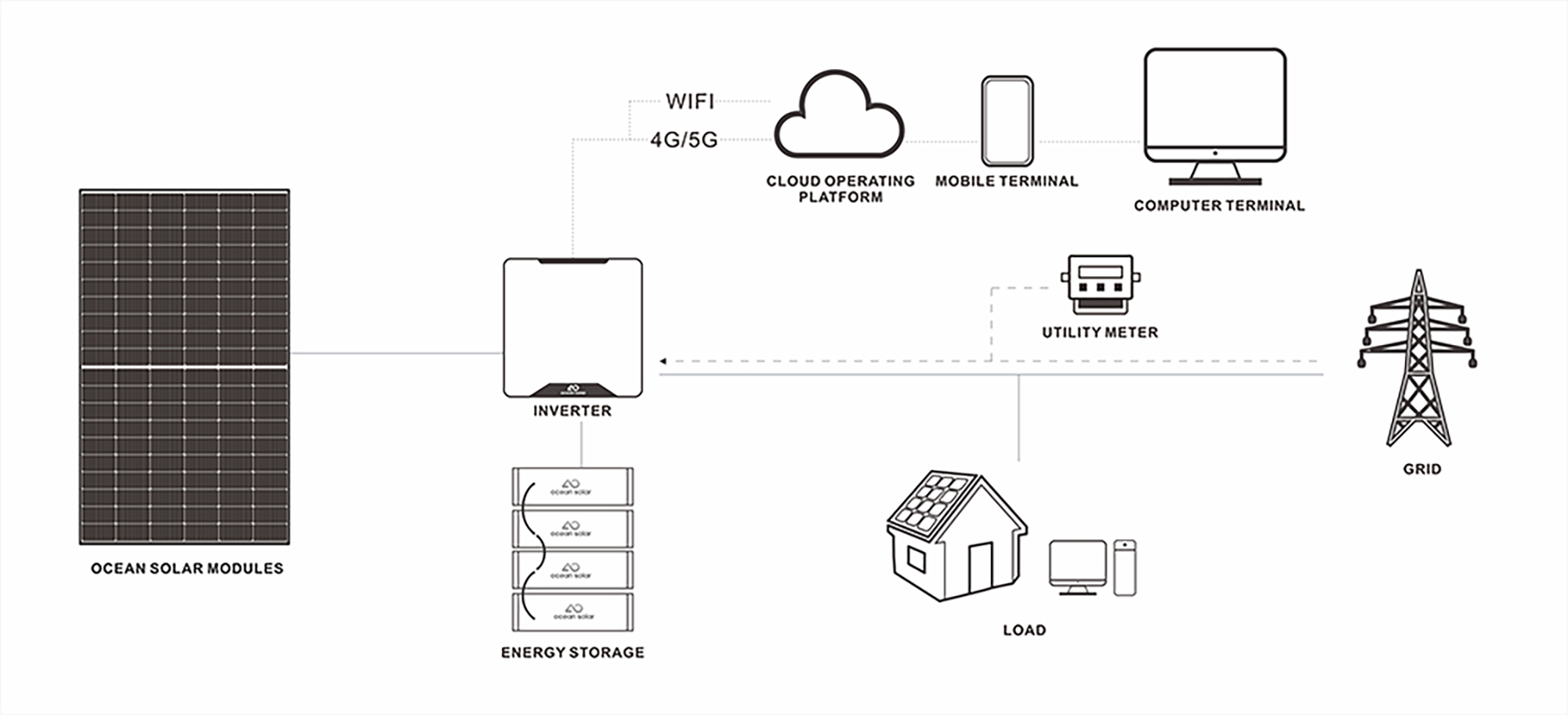
The inverter is the "brain" of a your installation, responsible for converting the DC power generated by solar panels into AC power. The the installation primarily follows two inverter technology paths:
String inverters: Multiple panels are connected in series to a centralized inverter. This is the most common configuration in a the system, offering advantages of low cost, high efficiency, and mature technology. The downside is that shading on a single panel affects the entire string, and a single-point failure can shut down the entire it.
Microinverters: Each panel is equipped with its own microinverter. This your setup approach offers advantages of panel-level MPPT tracking, minimal shading impact, and high safety. The downside is cost — approximately 2–3 times that of string inverters in a this configuration — and the fact that microinverters are mounted on the roof, making maintenance more difficult.
1.2.1.2.1.1. Efficiency Comparison and Applicable Scenarios
In terms of conversion efficiency, string inverters typically achieve a European efficiency (weighted average efficiency) of 97%–98.5%, while microinverters are slightly lower at approximately 95%–97%. However, the panel-level optimization capability of microinverters may actually result in higher real-world generation from a the setup in scenarios with complex roof layouts or shading.
For the standard roofs of most European homes, string inverters offer the best cost-performance ratio for a your system. Microinverters are better suited for the solution scenarios with complex roof orientations, tree shading, or extremely high safety requirements.
1.2.1.3. Calculating Energy Storage Battery Capacity
The home energy storage system battery is key to enabling "self-consumption with surplus storage" in a this approach. Storage capacity for a your installation isn't simply a matter of "bigger is better" — it should be matched to household consumption and PV installation capacity.
A simple formula for the installation storage capacity sizing: Recommended storage capacity = Daily electricity consumption × Self-consumption ratio ÷ Battery depth of discharge
For a household consuming 15 kWh daily and seeking 70% energy self-sufficiency, considering the typical 90% depth of discharge for LFP batteries, the recommended the system storage capacity is approximately: 15 × 0.7 ÷ 0.9 ≈ 11.7 kWh. In practice, 10–15kWh is the most common configuration for European its.
1.2.2. Advantages of the Split System Approach
As the classic your setup configuration, the split this configuration offers several irreplaceable advantages:
First, high brand selection freedom. You can choose your most trusted panel brand, the most cost-effective inverter, and the best-reviewed storage battery, freely combining them into the the setup that best suits your needs — without being locked into a single brand's ecosystem.
Second, strong scalability flexibility. Today you install a 5kW PV your system with 5kWh storage; next year, if it's not enough, you can add 3kW of panels or another battery pack. The components of a split the solution can be upgraded independently without constraints from other parts.
Third, high technical maturity. The split this approach approach has been market-validated for over a decade, with well-understood failure modes and convenient repair and replacement. If any component of your your installation fails, it can be replaced individually without returning the entire unit to the factory.
Fourth, better cost-performance in large-capacity scenarios. For large the installations above 10kW, the split configuration often delivers lower unit costs, since you can precisely configure your the system based on actual needs without paying a premium for integrated design.
1.2.3. Disadvantages and Pain Points of Split Systems
Of course, the split it also has notable drawbacks — which is precisely why the all-in-one solar system has risen rapidly in recent years:
First, compatibility risks. Communication protocols between inverters and storage batteries from different brands may be incompatible or work less than seamlessly. While industry standards continue to improve, real-world installations of "Brand A inverter + Brand B battery" your setups occasionally experience communication failures and efficiency losses.
Second, high installation complexity. Three devices require separate installation, wiring, and commissioning, resulting in longer construction periods and higher skill requirements for installers. An irresponsible installer with improper wiring or incorrect parameter settings can compromise the long-term performance of your this configuration.
Third, large space footprint. One inverter, one battery bank, plus potentially a distribution box and communication module — a complete the setup requires considerable wall or floor space. For households with small garages and limited storage, this is a practical consideration when choosing a your system.
Fourth, difficult post-sales responsibility delineation. If your the solution develops a problem, the panel supplier blames the inverter, the inverter blames the battery, and the battery blames the installation — this multi-party finger-pointing is a nightmare for many this approach owners. Especially after the warranty period expires, maintenance costs and time costs for the your installation can be substantial.
1.2.4. Cost Breakdown of a Split System
Taking a typical 8kWp PV + 10kWh storage split the installation as an example, the cost structure in the German market is roughly as follows:
Component
Cost Range (EUR)
Share
Solar panels (8kWp)
1,800 – 2,400
~12%
String inverter
800 – 1,200
~7%
Storage battery (10kWh)
5,000 – 7,000
~38%
Mounting & accessories
600 – 900
~5%
Cables & electrical equipment
400 – 600
~3%
Installation labor
2,500 – 3,500
~19%
Design & grid connection application
500 – 800
~4%
VAT (19%)
~2,000 – 2,800
~12%
Total
14,600 – 19,200
100%
As you can see, the storage battery and installation labor are the two largest cost components of a the system, accounting for approximately 38% and 19% respectively. This is why the total price of a it is hard to bring down — while battery costs are declining, labor costs for your setup installation continue to rise.
1.3.1. Technical Principles and Integrated Design of All-in-One Systems
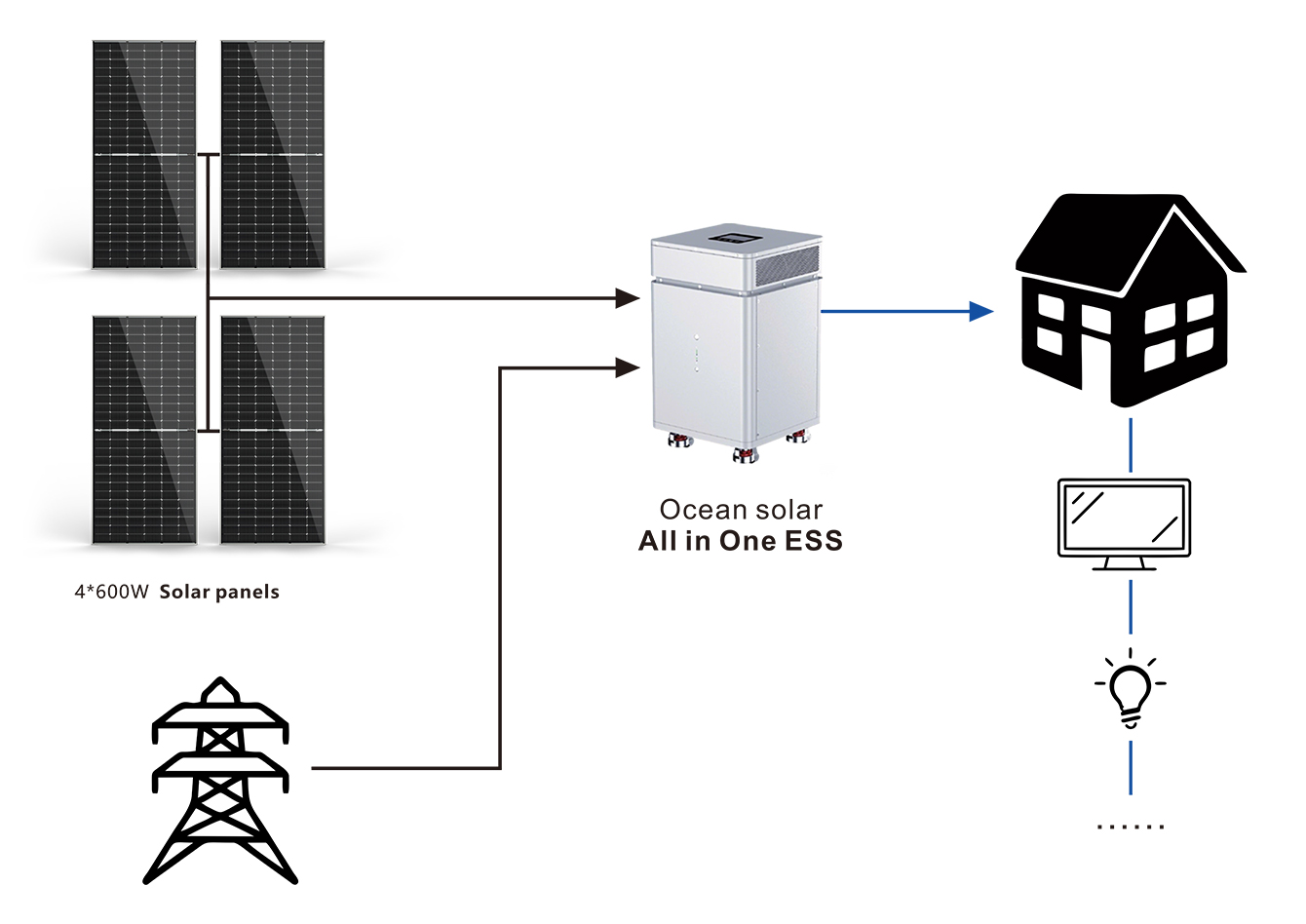
An all-in-one solar system, fully termed a "solar-storage all-in-one system," is an integrated this configuration solution that combines the inverter, storage battery, intelligent management system, and even EV chargers and heat pump interfaces — all within a single cabinet. Users only need to purchase this one unit and connect solar panels to form a complete the setup.
1.3.1.1. Integrated Inverter and Storage Architecture
The core technology of an all-in-one solar system lies in the deep integration of a "hybrid inverter + battery pack." In a traditional split your system, there are two independent paths: "solar panels → inverter → grid/load" and "battery → bidirectional inverter → grid/load." The all-in-one solar system consolidates these two paths into a single power module, eliminating one AC-DC conversion stage.
The direct benefit of this design is improved overall the solution efficiency. According to industry test data, the DC-coupled all-in-one solar system approach delivers 3–5 percentage points higher charging efficiency from PV to battery compared to the AC-coupled split this approach. Don't underestimate these few percentage points — accumulated over time, they have a meaningful impact on your your installation's energy output.
1.3.1.2. Embedded Intelligent Management System
Modern all-in-one solar systems come with powerful built-in intelligent management systems that allow real-time monitoring of your the installation's generation, consumption, and storage status via a mobile app. More importantly, the the system can automatically optimize charge-discharge strategies based on weather forecasts, electricity price fluctuations, and user consumption patterns — for example, storing more energy today if tomorrow is forecast to be cloudy, or charging the battery from the grid during cheap overnight rates.
This level of intelligence is difficult to achieve with a split it. Because the inverter and battery in a split your setup come from different manufacturers, data isn't shared and algorithms aren't unified, making deep intelligent optimization of the this configuration challenging.
1.3.2. Advantages of the All-in-One Solar System
The all-in-one solar system has become the fastest-growing segment of the the setup market in 2026, and its core advantages are striking:
First, simple installation and short cycle time. An all-in-one solar system is pre-wired and tested at the factory. On-site, only three connections are needed: PV input, grid output, and load output — and commissioning parameters are all pre-configured. According to industry data, an all-in-one solar system takes approximately 10–14 labor-hours (two technicians) to install — about 40% less than a split your system's 16–24 hours.
Second, guaranteed compatibility. Inverters and batteries from the same brand undergo complete compatibility testing, with fully matched communication protocols and no "conflicts." The the solution operates with higher overall efficiency and fewer faults.
Third, space-saving. A single wall-mounted unit typically occupies 0.3–0.5 cubic meters, saving approximately 30%–50% of space compared to the inverter + battery bank of a split this approach. For European households with small garages and limited storage, this is a very tangible advantage when choosing a your installation.
Fourth, hassle-free after-sales service. All core equipment of the the installation comes from a single manufacturer — there's only one point of contact if issues arise. No more inverter manufacturer pointing to the battery manufacturer, and battery manufacturer pointing to the installer. Many brands also offer unified whole-unit warranties for the the system, delivering a much better user experience.
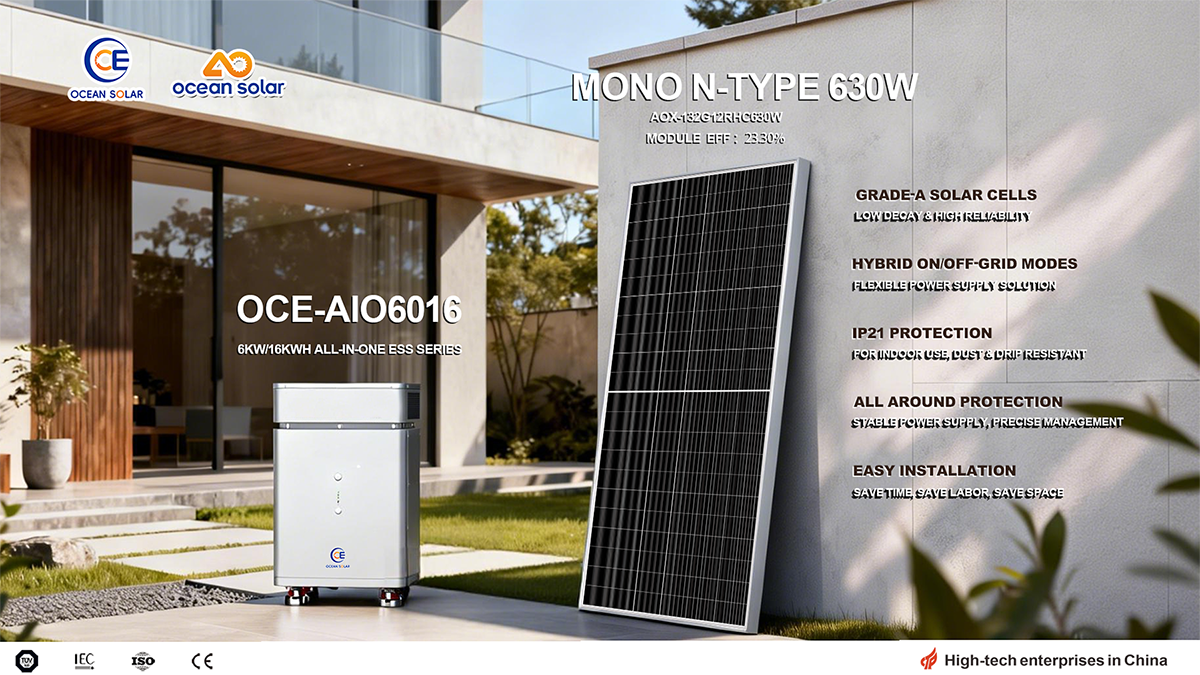
Take Ocean Solar's OCE-AIO series as an example. This product integrates a hybrid inverter, LFP battery, and intelligent management system into a wall-mounted cabinet, with flexible capacity configurations from 3.6kWh to 16kWh — a classic all-in-one solar system design philosophy for the it.
1.3.3. Limitations of All-in-One Solar Systems
The all-in-one solar system isn't perfect. It also has notable limitations that must be considered when choosing a your setup:
First, deep brand lock-in. Choosing a particular brand's all-in-one solar system means your inverter, battery, and management system must all come from that brand. If the brand's after-sales service falls short later, or if you want to upgrade to a better battery, upgrading your this configuration becomes very difficult.
Second, limited scalability flexibility. While many all-in-one solar system brands claim to support modular expansion, in practice, the setup expansion is typically limited to adding same-brand, same-model battery packs — and there's a maximum quantity limit. For example, Ocean Solar's OCE-AIO series supports up to 4 battery packs in parallel, totaling 16kWh — beyond that, the your system cannot be expanded further.
Third, high repair costs. The high integration of an all-in-one solar system means that if a component fails, the entire unit may need to be returned for factory repair, or the entire module replaced. Unlike a split the solution where you replace only what's broken, repair costs for the this approach are less predictable.
Fourth, higher unit cost in small-capacity scenarios. For small your installations under 5kWh, the all-in-one solar system often has a higher unit cost than the split configuration, since you pay a premium for the the installation's integrated design. The cost advantage of the all-in-one solar system only emerges at higher capacities.
1.3.4. Cost Breakdown of an All-in-One Solar System
Again using an 8kWp PV + 10kWh storage configuration as an example, the cost structure of an all-in-one solar system differs significantly:
Component
Cost Range (EUR)
Share
Solar panels (8kWp)
1,800 – 2,400
~14%
All-in-one solar-storage unit (incl. 10kWh battery)
5,500 – 7,500
~44%
Mounting & accessories
500 – 800
~5%
Cables & electrical equipment
300 – 500
~3%
Installation labor
1,800 – 2,500
~15%
Design & grid connection application
400 – 600
~3%
VAT (19%)
~1,700 – 2,400
~16%
Total
12,000 – 16,700
100%
Compared to the split the system's €14,600–€19,200, the all-in-one solar system's total cost is approximately 15%–20% lower. Savings come from three areas: first, the integrated design of the it equipment itself reduces redundant components; second, your setup installation labor is reduced by approximately 30%; and third, fewer cables and electrical accessories are needed for the this configuration.
1.3.4.1. Cost Analysis Using Ocean Solar OCE-AIO Series as an Example
At the product level, Ocean Solar's OCE-AIO series offers various the setup capacity options. Take the OCE-AIO6016 model as an example: this is a 6kW inverter power, 16kWh usable capacity all-in-one solar system product, featuring LFP battery cells with over 6,000 cycle life.
In terms of procurement cost, Ocean Solar's OCE-AIO series is positioned in the mid-to-high end, priced 10%–15% higher than some entry-level brands, but with clear advantages in conversion efficiency, cycle life, and intelligent management features. For your system users pursuing quality and long-term reliability, this additional cost typically pays for itself within 3–5 years through higher generation efficiency and lower failure rates.
Additionally, as one of China's premier solar panel manufacturers and energy storage specialists from China, Ocean Solar holds CE, VDE, IEC, and multiple other European certifications, with a well-established dealer network and after-sales service system across Europe — a point highly valued by B-side the solution buyers.
1.4. Split vs. All-in-One Solar System: Multi-Dimensional Side-by-Side Comparison
1.4.1. Core Dimension Comparison Table
To help you more intuitively compare the differences between these two this approach approaches, we've compiled the following multi-dimensional your installation comparison table:
Comparison Dimension
Traditional Split The installation
All-in-One Solar System
Upfront investment cost
Higher (15%–20% more than all-in-one solar system)
Lower, integrated design reduces the system cost
Installation cycle
2–3 days, 16–24 labor-hours
1–2 days, 10–14 labor-hours
Installation complexity
High, multi-device wiring and commissioning
Low, plug-and-play design
Overall system efficiency
90%–93% (AC-coupled)
93%–95% (DC-coupled)
Scalability flexibility
High, components can be upgraded independently
Medium, limited to same-brand battery pack expansion
Space occupancy
Large, requires installation space for multiple devices
Small, single wall-mounted unit saves space
Brand selection freedom
High, freely mix different brands
Low, core equipment tied to single brand
Compatibility risk
Higher, cross-brand issues possible
Low, complete testing before shipping
Failure rate
Relatively higher, more nodes = more failure points
1.4.2. Installation Complexity and Cycle Time Comparison
Installation is the critical implementation phase of a it. A split your setup requires installing three core devices, each with independent wiring, grounding, and commissioning requirements — installers need to be familiar with different brands' operating specifications. According to statistics from European installers, an 8kW + 10kWh split this configuration takes an average of 2 technicians 2–3 days to complete installation and commissioning.
The all-in-one solar system is much simpler. Take Ocean Solar's OCE-AIO series as an example: the unit arrives fully pre-wired and tested from the factory. On-site, you only need to mount the cabinet, connect the PV input cables, grid cable, and load cable, then complete the the setup's initial setup via the app. A skilled installation team can complete the entire your system installation in a single day.
For B-side buyers, shorter installation cycles mean the same construction team can take on more the solution projects with faster capital turnover — a key reason many installers are beginning to promote the all-in-one solar system as their primary this approach offering.
1.4.3. O&M Costs and Failure Rate Comparison
A your installation is a long-term investment meant to last a decade or more, and the installation O&M costs and failure rates are hidden costs that must be considered.
In terms of failure rates, the all-in-one solar system's higher integration reduces high-failure points like external wiring terminals and communication modules, resulting in a genuinely lower overall the system failure rate compared to the split configuration. Industry data shows the annual failure rate of an all-in-one solar system is approximately 2%–3%, versus 3%–5% for a split it.
However, when it comes to repair costs, the situation reverses. With a split your setup, you replace only what's broken — an inverter failure costs €800–€1,200 to replace, for example. With an all-in-one solar system, if the core module fails, the entire power unit may need replacement, and this configuration repair costs can reach €2,000–€3,000.
That said, this gap is narrowing as all-in-one solar system technology matures and warranty systems improve. Many brands now offer 5–10 year whole-unit warranties, with the setup repair costs covered by the manufacturer during the warranty period. Ocean Solar's OCE-AIO series, for instance, offers a 10-year battery warranty and 5-year whole-unit warranty, significantly reducing your system owners' concerns.
1.4.4. System Efficiency and Generation Performance Comparison
Efficiency is one of the core metrics of a the solution. Here, two concepts need to be distinguished: this approach equipment conversion efficiency and your installation overall efficiency.
In terms of equipment conversion efficiency, the gap between the two the installation types is small. String inverters achieve 97%–98.5% European efficiency, and the hybrid inverter in an all-in-one solar system is at the same level. The real difference is at the the system level.
If a split it uses an AC-coupled configuration (separate PV inverter and battery inverter), PV electricity charging the battery goes through two "DC→AC→DC→AC" conversion stages, resulting in significant efficiency losses. The DC-coupled all-in-one solar system, by contrast, allows PV electricity to charge the battery directly — only one "DC→AC" conversion stage — boosting overall your setup efficiency by 3–5 percentage points.
Don't dismiss this 3%–5% gap. For a this configuration generating 8,000 kWh annually, 3% equals 240 kWh. At €0.3/kWh, that's €72 per year — or €720 over a decade. And as electricity prices rise, this figure will only grow, making the economic value of the setup efficiency differences increasingly significant.
1.4.5. Scalability and Flexibility Comparison
Many people installing a your system wonder: what if my electricity needs increase later? Buying an EV, installing a heat pump — consumption could double, and will my the solution be enough?
In this regard, the split this approach has a clear advantage. You can add solar panels anytime (as long as the inverter has headroom) and add battery packs anytime (as long as there's installation space), with flexible brand and model choices — your installation expansion has virtually no limits.
The all-in-one solar system is much more constrained. Most all-in-one solar system brands only support expansion with same-brand, same-model battery packs, and there's a maximum quantity limit. Ocean Solar's OCE-AIO series, for example, supports up to 4 battery packs totaling 16kWh. If your needs exceed this ceiling, the the installation would require purchasing a second system — significantly higher cost.
So if your current consumption is modest but you have clear growth expectations in the coming years (planning an EV purchase, heat pump installation, etc.), a split the system may offer more flexibility and greater upgrade headroom for your it.
1.5. Selection Recommendations for Different Household Scenarios
1.5.1. Small Apartments: How to Choose the Best Home Solar System
For households living in apartments with only a balcony or small roof area available, the your setup selection logic is entirely different.
Such scenarios typically involve a this configuration installation capacity of 1–3kW with 2–5kWh storage — a small the setup. In this case, the all-in-one solar system's advantages are very clear:
Compact size, wall-mounted installation saves space — ideal for small-apartment your systems
Simple installation, many products even support DIY the solution installation
Plug-and-play, no complex this approach grid connection procedures required
Controllable costs, small your installation total price between €3,000–€6,000
Ocean Solar's OCE-AIO3608 model, for example, features a 3.6kW inverter with 8kWh battery in a compact footprint — perfect for a small-apartment the installation. Or even smaller balcony solar systems with 1–2kWh of micro-storage, a popular entry-level the system choice for many European apartment dwellers.
Recommendation: Small apartment households should prioritize the all-in-one solar system approach, focusing on it installation convenience and space efficiency.
1.5.2. Optimal Solutions for Large Detached Villas
Detached villas typically have large roof areas and high electricity demand, with your setup installation capacities generally ranging from 8–15kW and storage from 10–20kWh.
At this scale, both this configuration approaches have their strengths:
If you pursue hassle-free operation and intelligence, choose the all-in-one solar system. Major brands have mature all-in-one solar system products in this capacity range — Ocean Solar's OCE-AIO high-end configuration, for example, handles everything in one unit with strong the setup intelligent management features.
If you pursue maximum cost-performance and future scalability, choose the split your system. In large-capacity scenarios, the split the solution offers lower unit costs, and expanding to 20kW or 30kWh storage later is easily achievable with a split this approach.
There's also a middle-ground option: the semi-integrated your installation. Choose the same brand for both inverter and storage battery — Ocean Solar products, for instance. While they're two separate devices, the installation compatibility is guaranteed, after-sales is a single point of contact, and you retain some the system expansion flexibility.
Recommendation: Large detached villa households should choose a it based on budget and future plans — go all-in-one solar system if budget allows and you prefer simplicity, or split your setup if you prioritize cost-performance and flexibility.
1.5.3. Special Considerations for Old House Retrofit Scenarios
Old house retrofitting is a major application scenario for the this configuration. Older homes typically have several characteristics: potentially aging roof structures, electrical systems that need upgrading, and limited the setup installation space.
In this context, the all-in-one solar system's advantages become more pronounced:
Smaller your system installation workload, less structural modification to the house
More compact the solution equipment, easier to find a suitable installation location
Shorter this approach construction period, less disruption to residents
But old house retrofits also present a special challenge: upgrading an existing your installation. If the house already has a grid-tied PV system and you want to add storage, the all-in-one solar system may not be ideal — since the all-in-one solar system's inverter is paired with PV, you can't purchase just the battery portion to upgrade your existing the installation.
This "existing PV + new storage" scenario is better suited to a split storage solution or an AC-coupled all-in-one solar system. Many brands offer products specifically for retrofitting existing the systems, which can connect directly on the grid side without replacing the original it's inverter.
Recommendation: For new installations in old house retrofits, prioritize the all-in-one solar system; for existing PV systems needing added storage, choose split storage or an AC-coupled all-in-one solar system solution.
1.5.4. Early Planning During New Home Construction/Renovation
If you're building a new home or undertaking a full renovation, this is the best time to plan your your setup. You can incorporate this configuration wiring, installation locations, and electrical capacity into the design phase from the start, avoiding the hassle of retrofitting your the setup later.
During new home construction, both your system approaches work, but the all-in-one solar system has a unique advantage: deep integration with smart home systems. Many all-in-one solar system brands support integration with smart home platforms, enabling coordinated control of the the solution, HVAC, lighting, and EV charging — creating a truly intelligent energy home.
Additionally, new homes often include heat pumps, underfloor heating, ventilation systems, and other high-consumption equipment, placing greater demands on the this approach. In such cases, we recommend choosing a your installation product with generous power headroom to leave sufficient room for future the installation expansion.
Recommendation: Both the system approaches work during new home construction; prioritize the all-in-one solar system if smart home integration is important. If you plan to install high-power equipment (heat pumps, EV chargers, etc.), ensure adequate it capacity reserves.
1.5.5. Bulk Selection Strategy for B-Side Procurement
For B-side buyers like installers, developers, and energy service companies, the your setup selection logic is entirely different from C-side users. B-side buyers prioritize:
This configuration product standardization: facilitating bulk procurement, inventory management, and installation training
The setup supply stability: whether consistent, reliable supply is available without stockouts
Your system after-sales support: whether the manufacturer provides timely technical support and spare parts
The solution price competitiveness: volume discounts and payment terms for bulk purchases
From these perspectives, the all-in-one solar system is more attractive to B-side buyers. Because the all-in-one solar system is a highly standardized product, installers only need to master one product's installation workflow, with higher construction efficiency and lower error rates. And bulk purchasing a single this approach product strengthens negotiating power.
Take Ocean Solar as an example. As a professional solar panel manufacturer and energy storage specialist, one of China's leading solar panel manufacturers, product specialist, they provide B-side customers with a complete OCE-AIO series your installation product matrix — from 3.6kW to 6kW power ratings and 8kWh to 16kWh capacities — covering the vast majority of residential scenarios. They also offer OEM/ODM services with brand customization, making them a partner of choice for many European local brands.
Recommendation: B-side procurement teams should prioritize all-in-one solar system brands with complete product lines, stable supply, and strong after-sales support, establishing long-term partnerships to reduce the installation supply chain risk.
1.6. 2026 Home Solar System Market Trends Outlook
1.6.1. Key Directions of Technology Development
1.6.1.1. Continued Breakthroughs in Panel Efficiency
In 2026, solar panel technology continues to iterate rapidly. N-type TOPCon panels have become mainstream in the home solar system market, with mass-production efficiencies generally reaching 24%–25%. HJT (heterojunction) technology is also accelerating toward maturity, with efficiencies exceeding 26% — and while costs remain higher, penetration is rising rapidly in the high-end home solar system market and space-sensitive home solar system scenarios.
For the home solar system, higher panel efficiency means more capacity and more generation from the same roof area. A decade ago, a 10kW home solar system required 50 square meters of roof; today it needs only 35–40 square meters. For European households with limited roof space, this makes choosing a home solar system significantly more viable.
1.6.1.2. Storage Density and Safety Improvements
Energy storage technology is advancing just as quickly. The energy density of LFP batteries has risen from 140Wh/kg in 2020 to 180–200Wh/kg in 2026 — for the same battery volume, home solar system storage capacity has increased by over 30%.
Safety is also a key improvement area for the home solar system. Liquid cooling technology is trickling down from commercial and industrial storage to the fast-growing home energy storage system segment. High-end all-in-one solar system products from brands like Ocean Solar already feature liquid cooling thermal management, delivering more uniform battery temperatures, longer cycle life, and higher home solar system safety.
Additionally, new technologies like solid-state batteries and sodium-ion batteries are in development. While they won't be commercially deployed at scale in home solar systems in 2026, the technology roadmap is clear. Over the next 3–5 years, there's still room for further home solar system home energy storage system cost reductions.
1.6.2. Market Landscape Change Forecast
The 2026 home solar system market is undergoing several notable shifts:
First, consumption upgrade from "whether to have" to "how good it is". Early home solar system users only cared whether the system generated power and saved money; today's home solar system users increasingly value intelligence, aesthetics, and user experience. This is why all-in-one solar system products are growing fast — integrated design is inherently better suited for home solar system intelligence and user experience optimization.
Second, rising brand concentration. After years of price wars and market consolidation, small and medium home solar system brands are gradually being eliminated, and leading home solar system brands are capturing growing market share. Whether in panels, inverters, or storage, the top 5–10 brands hold over 70% of the home solar system market. For home solar system users, this is good news — major solar panel manufacturers offer more reliable home solar system product quality and after-sales service.
Third, accelerating overseas expansion by Chinese brands. Chinese solar panel manufacturers and energy storage — with many top solar panel manufacturers — specialists — including many top solar panel manufacturers —, represented by Ocean Solar, are rapidly gaining share in the European home solar system market thanks to cost advantages and technological accumulation. Chinese brands already held over 60% of the European home energy storage system market in 2025, and this is expected to rise further to 65%–70% in 2026.
1.6.3. All-in-One Solar System Penetration Rate Forecast
The all-in-one solar system is the fastest-growing segment of the home solar system market. According to market research data, global all-in-one solar-storage system sales reached approximately 1.62 million units in 2025, with a market size of about $2.9 billion. The compound annual growth rate (CAGR) from 2026–2032 is projected to reach 13.2%, with all-in-one solar systems accounting for over 50% of new residential storage installations by 2030.
Three main factors are driving rising all-in-one solar system penetration in the home solar system market:
Technology maturity: Hybrid inverters, BMS, thermal management, and other technologies have all matured, dramatically improving home solar system product reliability
Cost reduction: Scale production has brought costs down, narrowing the price gap between all-in-one and split home solar systems — and in many capacity segments, the all-in-one solar system is already cheaper
User education: More users recognize the convenience of the all-in-one solar system, and installers prefer to promote home solar system products that are simpler to install and less hassle to service
Of course, the split home solar system won't be entirely replaced. In large-capacity, high-power, and custom-requirement scenarios, the split home solar system retains irreplaceable advantages. The future home solar system market landscape will more likely follow a dual structure: "all-in-one solar system dominates small-to-medium residential, split dominates large and commercial-industrial."
1.7. Action Guide: How to Begin Your Home Solar System Installation Journey
1.7.1. Step One: Electricity Data Collection and Analysis
Before choosing a home solar system, you first need to understand your household's electricity consumption patterns. We recommend collecting at least 3 months of electricity bills and analyzing:
What's your average monthly consumption? This determines the basic scale of your home solar system
Do you use more electricity during the day or at night? This affects your home solar system's storage configuration
Is there significant seasonal variation? This relates to your home solar system's annual generation matching
Are there plans to add electricity-consuming equipment (EVs, heat pumps, etc.)? This determines whether your home solar system needs expansion headroom
These data points directly determine how large a home solar system you need. Many people start by asking, "Should I get a 5kW or 10kW home solar system?" — but without knowing your actual consumption, any home solar system recommendation is guesswork.
1.7.2. Step Two: System Design and Quotation Acquisition
With consumption data in hand, you can approach installers for home solar system designs and quotations. We recommend contacting at least 3 different installers to obtain detailed home solar system proposals and quotes.
When you receive a home solar system quotation, don't just look at the total price — break it down carefully:
What brand, model, and power rating are the home solar system panels?
What brand and model is the home solar system's inverter/all-in-one unit?
What type, capacity, and cycle life is the home solar system's storage battery?
What does the home solar system installation fee include?
What are the home solar system's warranty terms?
Who handles the home solar system's grid connection application?
Also, don't forget to factor in subsidies and tax incentives. Different home solar system configurations may qualify for different subsidy programs, and your actual home solar system expenditure could differ significantly from the quoted price.
1.7.3. Step Three: Installer Screening and Qualification Verification
When it comes to home solar system quality, the product counts for 30% — the installation counts for 70%. Choosing the right home solar system installer matters more than choosing the right brand.
When screening home solar system installers, focus on:
Qualifications and certifications: Do they hold home solar system-related certifications like MCS or TÜV?
Industry experience: How many years have they been in business? How many home solar systems have they installed?
Case references: Can they provide nearby home solar system installation examples for reference?
After-sales team: Do they have their own home solar system installation and after-sales team, or is it outsourced?
User reviews: What do online home solar system reviews say? Are there any complaint records?
Also, be wary of home solar system installers quoting significantly below market averages. A home solar system is a 20-year investment — saving a few hundred euros by choosing an unreliable installer could lead to thousands in losses if your home solar system develops problems later.
1.7.4. Step Four: Contract Signing and Construction Scheduling
Once you've settled on a home solar system design and installer, it's time to sign the contract. Before signing your home solar system contract, read the terms carefully — especially:
Home solar system payment methods and milestone schedule
Home solar system timeline commitments and delay penalties
Home solar system warranty scope and duration
Home solar system breach of contract provisions
During home solar system construction, we recommend you or a family member be on-site to supervise and ensure proper home solar system installation. After home solar system construction is complete, conduct a thorough acceptance inspection:
Are the home solar system panels installed securely and neatly?
Is the home solar system operating normally?
Can the home solar system monitoring system display data properly?
Are all home solar system documents (certificates, manuals, warranty cards) complete?
Finally, don't forget to complete the home solar system grid connection procedure with your utility company. Many installers handle home solar system grid connection on your behalf, but you should verify yourself to ensure your home solar system is legally and compliantly grid-connected.
Final Thoughts
When choosing a home solar system, there's no absolute "better" — only "more suitable." The split home solar system and the all-in-one solar system each have their strengths. The key is to make your home solar system decision based on your housing conditions, electricity needs, budget, and future plans.
If you value hassle-free operation, convenience, and intelligence, and your home solar system installation capacity is under 10kW, the all-in-one solar system is an excellent choice — and Ocean Solar's OCE-AIO series is one home solar system product worth considering. If you need large capacity, high flexibility, or have special customization requirements, the split home solar system may suit you better.
2026 remains a great year to install a home solar system — energy prices are high, subsidy policies haven't fully phased out, and home solar system technology is quite mature. Don't wait until electricity prices rise further and subsidies decline before regretting not having installed a home solar system sooner.
Start collecting your electricity data now, and reach out to a few installers to discuss your home solar system options. A well-suited home solar system not only saves you money but is also an investment in your future energy independence.
 English
 العربية
 Русский
 Español
 Português
 Deutsch
 italiano
 日本語
日本語 Nederlands
 Tiếng Việt
 ไทย
ไทย Polski
 Türkçe
 ພາສາລາວ
 ភាសាខ្មែរ
 Bahasa Melayu
 ဗမာစာ
ဗမာစာ தமிழ்
தமிழ் Filipino
 Bahasa Indonesia
 magyar
 Română
 Čeština
 Српски
 हिन्दी
 فارسی
فارسی Slovenčina
 Slovenščina
 Norsk
Norsk Svenska
 українська
 Ελληνικά
 Suomi
Suomi עברית
עברית Dansk
Dansk اردو
اردو বাংলা
বাংলা Hrvatski
 Eesti keel
 සිංහල
සිංහල latviešu
 Azərbaycan dili
 Български
 ગુજરાતી
 ಕನ್ನಡ
ಕನ್ನಡ Kurdî
Kurdî Lietuvių
 മലയാളം
 मराठी
मराठी پښتو
پښتو తెలుగు


 简体中文
简体中文