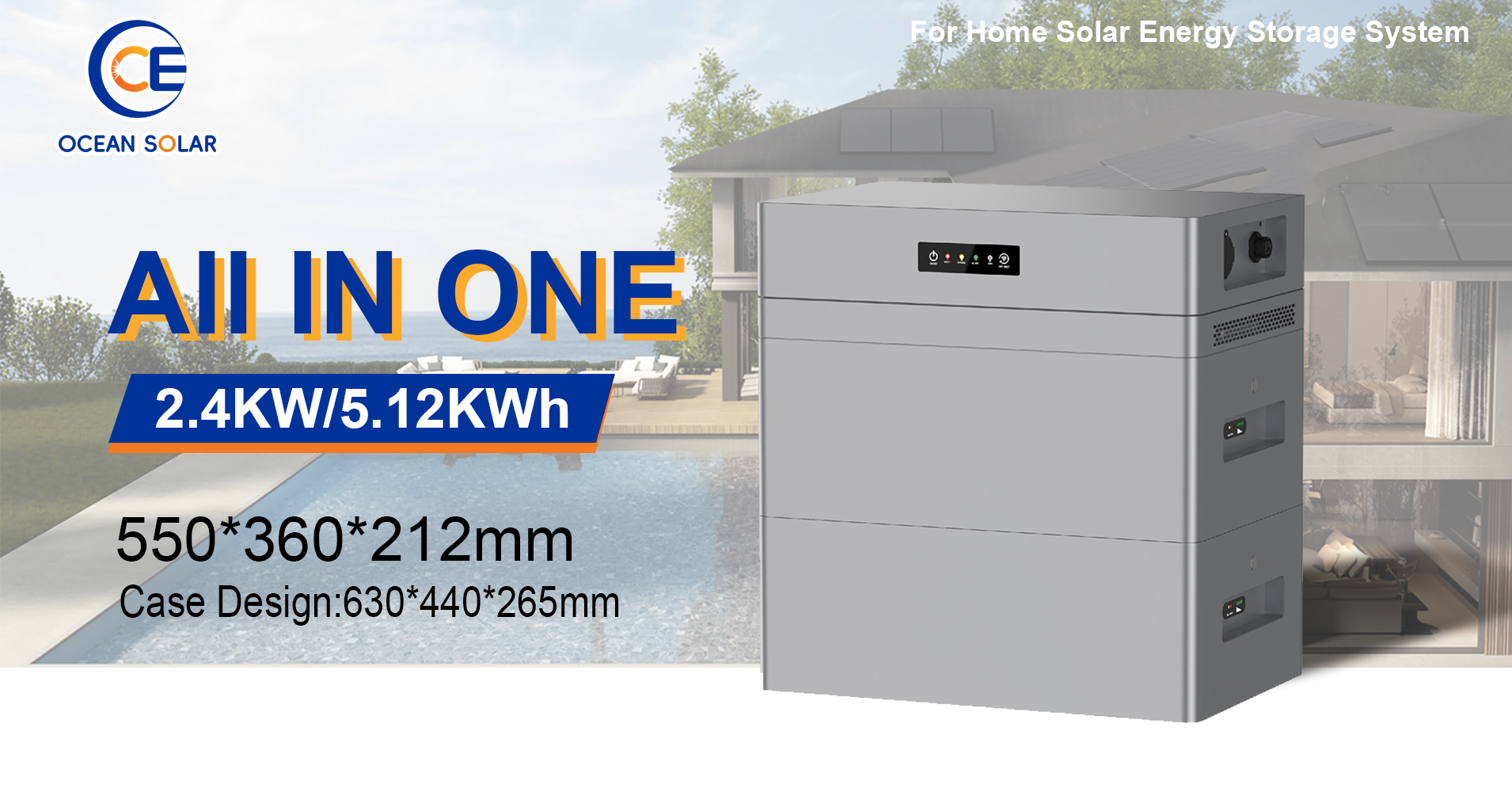
OCE-AONE2400 2.4kW 5.12kWh All-in-One Balcony ESS
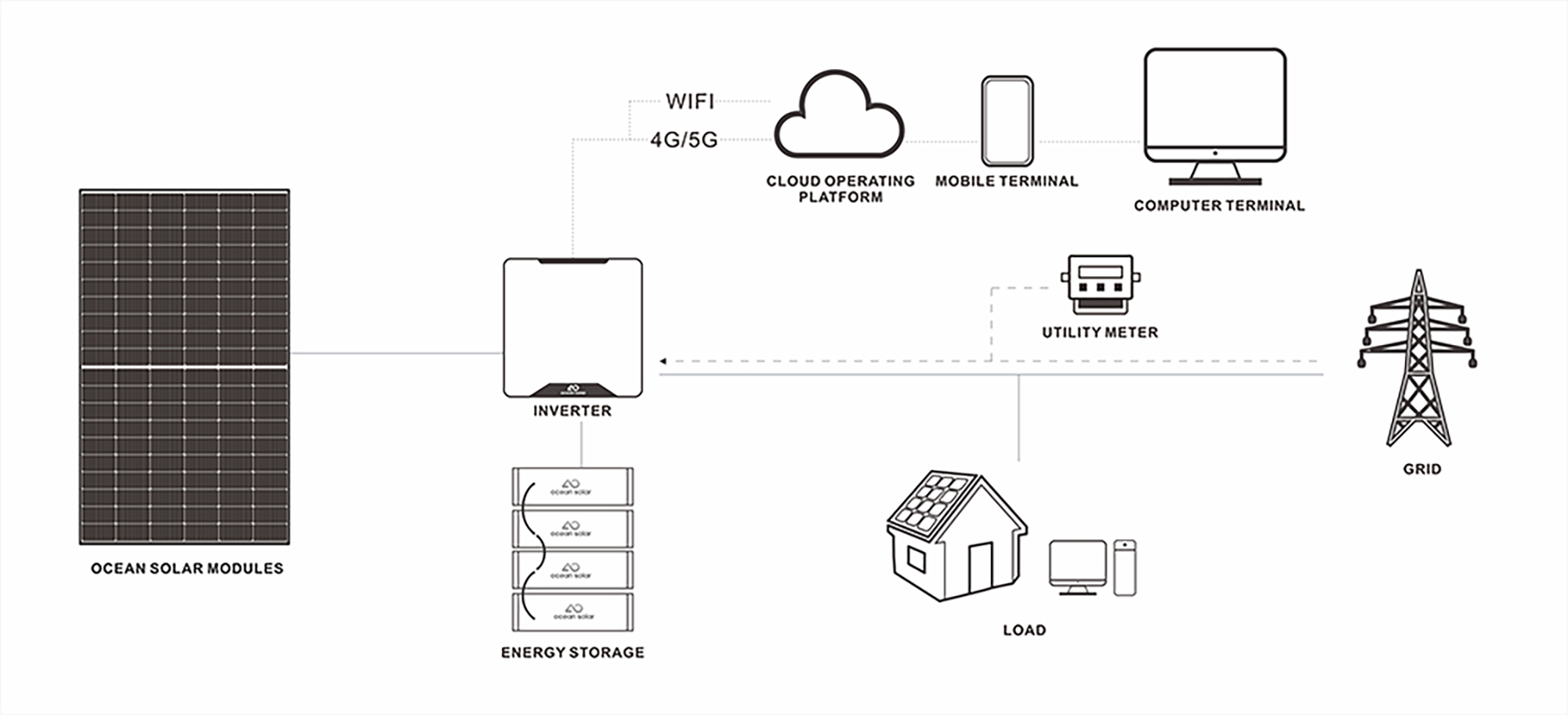
The Ocean Solar OCE-AONE2400 is a 2.4kW / 5.12kWh all-in-one balcony energy storage system designed for residential solar self-consumption, home backup power and smart energy management. It combines a bidirectional inverter, LiFePO4 battery platform, PV charging and battery management functions in a compact stackable system.
The system delivers 2400W rated pure sine wave AC output and uses a 5.12kWh, 51.2V, 100Ah lithium iron phosphate battery. Three PV input channels support up to 2400W of solar input, while the IP65 enclosure supports suitable indoor or outdoor installation environments.
For backup applications, the OCE-AONE2400 provides a typical grid-to-inverter conversion time of 10ms and a specified UPS backup switching time below 20ms. CAN, RS485 and APP monitoring functions support system status monitoring and energy management.
OCE-AONE2400 Key Specifications
| Parameter | Specification |
| Model | OCE-AONE2400 |
| System Type | All-in-One Balcony Energy Storage System |
| Rated AC Output | 2400VA / 2400W |
| Battery Capacity | 5.12kWh / 5120Wh |
| Battery Chemistry | LiFePO4 |
| Battery Voltage / Capacity | 51.2V / 100Ah |
| Maximum PV Input Power | 2400W Total, 800W × 3 Channels |
| PV Input Current | 20A × 3 Channels |
| Maximum PV Open-Circuit Voltage | 108VDC |
| PV Operating Voltage Range | 10VDC-108VDC |
| MPPT Voltage Range | 10VDC-95VDC |
| UPS Switching Time | <20ms, 10ms Typical |
| Protection Rating | IP65 |
| AC Input | 220/230VAC |
| AC Input Voltage Range | 170VAC-280VAC ±2% @ UPS |
| Frequency | 50Hz / 60Hz Auto Detection |
| Output Waveform | Pure Sine Wave |
| AC Mode Efficiency | >95% |
| Inverter Mode Maximum Efficiency | >93% |
| Operating Temperature | -25°C to +60°C |
| Operating Humidity | 0-98%, Non-Condensing |
| Noise | <45dB @ 1m |
| Communication | CAN, RS485, APP Monitoring & Control |
What Is an All-in-One Balcony Energy Storage System?
An all-in-one balcony energy storage system combines the main functions required for residential solar generation, battery storage and backup power into a coordinated system. Compared with a conventional installation that requires separate solar charge controllers, batteries, inverters and communication devices, an integrated design can simplify equipment selection, wiring and system management.
The OCE-AONE2400 uses a stackable inverter and battery architecture. The upper inverter module handles AC conversion, PV charging and system control, while the 5.12kWh LiFePO4 battery module stores energy for evening use, backup power and other residential energy-management applications.
This architecture is particularly relevant for balconies, terraces, small residential solar systems and homes requiring compact energy storage without building a conventional multi-component battery system.
2.4kW Pure Sine Wave Inverter
The integrated inverter provides 2400VA / 2400W rated AC output at 230VAC using a pure sine wave output waveform. This allows the system to supply appropriately sized residential loads while maintaining an AC waveform suitable for common household electrical equipment.
The AC input operates at a nominal 220/230VAC with a specified 170-280VAC input range in UPS mode. The system automatically detects 50Hz or 60Hz frequency, while the maximum bypass overload current is specified at 16A.
Typical 10ms Backup Switching
When the grid supply is interrupted, the OCE-AONE2400 can transfer supported backup loads from bypass operation to inverter operation. The current datasheet specifies a typical conversion time of 10ms and UPS backup switching below 20ms.
Backup-load selection should remain within the 2400W rated inverter output and should account for the startup characteristics of refrigerators, pumps, motors and other inductive loads.
Three PV Input Channels with Up to 2400W Solar Input
The OCE-AONE2400 provides three PV input channels. Each channel supports up to 800W of PV input power and up to 20A input current, providing a combined maximum PV input capacity of 2400W.
The maximum PV open-circuit voltage is 108VDC. The specified PV operating voltage range is 10-108VDC and the MPPT operating voltage range is 10-95VDC.
When selecting solar panels, system designers must verify each PV input channel against module Voc, Vmp, Isc and Imp values. Cold-weather Voc must remain below the 108V maximum PV open-circuit voltage.
Adjustable PV and Hybrid Charging
PV charging current can be configured from 0 to 60A across the three channels. The current datasheet also specifies a maximum combined AC plus PV charging current setting of up to 80A.
AC charging supports a configurable maximum charging current of 50A with a specified AC charging voltage range of 184-253VAC.
5.12kWh LiFePO4 Battery Storage
The battery module uses lithium iron phosphate chemistry with a nominal voltage of 51.2V, 100Ah rated capacity and 5120Wh nominal energy capacity at the stated test condition.
The specified battery operating voltage range is 40.0-58.4V. Maximum continuous charge and discharge currents are 50A and 100A respectively, with a specified maximum pulse discharge current of 150A for one second.
Integrated Battery Protection
The system includes protection functions for overcharge, overdischarge, overcurrent, short circuit and overtemperature conditions. CAN and RS485 communication interfaces support communication between the battery, inverter and compatible monitoring systems.
UN38.3 and MSDS Battery Documentation
The current battery specification lists UN38.3 and MSDS documentation. Buyers should request the current versions of battery transport documents and any destination-market electrical or grid certificates required for shipment, installation or local distribution.
IP65 Outdoor Energy Storage Design
Both the inverter system and battery specification identify IP65 protection, making the OCE-AONE2400 suitable for appropriately protected balcony, terrace and other residential installation locations where dust and water exposure must be considered.
IP65 does not mean the equipment can be submerged. Installation should maintain appropriate ventilation, drainage, cable routing, mounting support and access for inspection while following the installation manual and local electrical requirements.
-25°C to +60°C Operating Temperature
The specified operating temperature range is -25°C to +60°C with operating humidity from 0% to 98% under non-condensing conditions. The inverter uses fan cooling and has a specified operating noise below 45dB at one meter.
Inverter and Battery Dimensions
| Component | Product Dimensions | Net Weight | Packaging |
| Inverter Module | 550 × 360 × 156mm | 12.1kg | 630 × 440 × 295mm, 15kg Gross |
| 5.12kWh Battery Module | 550 × 360 × 212mm | 44.4kg | 630 × 440 × 265mm, 46.4kg Gross |
Stackable All-in-One System Architecture
The inverter and battery modules share a coordinated footprint for stackable installation. This reduces the space required by separate wall-mounted inverter and battery components and creates a cleaner residential energy storage installation.
The current datasheet confirms stackable installation but does not specify the maximum number of battery modules that can be electrically paralleled. Customers requiring capacity expansion should therefore confirm the supported battery quantity, communication configuration and maximum system capacity before ordering.
Smart APP Monitoring, CAN and RS485 Communication
OCE-AONE2400 supports APP monitoring and control for convenient residential energy management. CAN and RS485 interfaces are also included for battery communication and compatible system integration.
Depending on the final software configuration, system monitoring can be used to review operating status, battery state of charge, charging and discharging behavior and other available energy data.
Where Is the OCE-AONE2400 Used?
Balcony Solar Energy Storage
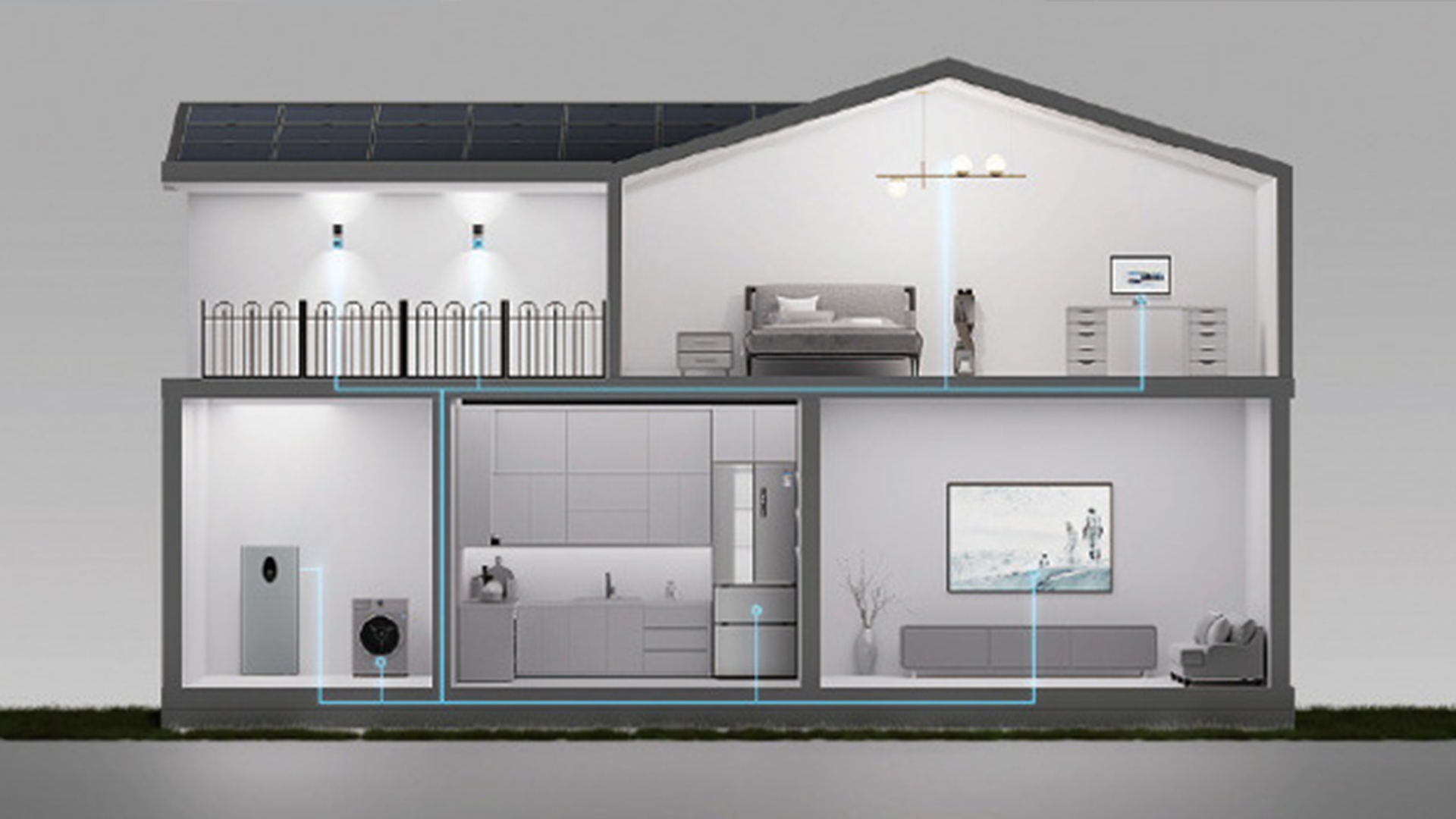
The compact IP65 design makes the OCE-AONE2400 relevant to balcony and terrace solar-storage applications where daytime PV generation can be stored for later household use.
Residential Solar Self-Consumption
Battery storage can shift surplus daytime solar energy to evening or other periods when household consumption exceeds instantaneous PV generation, subject to the final system configuration and local grid requirements.
Home Backup Power
During a grid interruption, the 2400W inverter and 5.12kWh battery can support appropriately selected backup loads. Actual backup duration depends on usable battery energy, connected load, inverter losses, battery state of charge and ambient operating conditions.
Small Home and Remote Energy Systems
The system can also be evaluated for appropriately sized small residential or remote energy applications requiring PV charging, battery storage and 230VAC output from one coordinated ESS platform.
Grid Connection and Installation Requirements
The OCE-AONE2400 is designed to simplify residential energy storage installation, but grid-connected use is subject to local electrical codes, permitted inverter export limits, socket or fixed-wiring requirements, grid certification and registration rules.
A 2400W inverter should not automatically be treated as an approval-free balcony plug-in device in every country. Installers and system owners should confirm local grid and electrical requirements before connecting the system to household wiring or exporting electricity to the public grid.
Where local regulations or fixed electrical connections require it, installation should be completed or verified by a qualified electrician.
Download the OCE-AONE2400 Datasheet
 OCE-AONE2400 2.4kW / 5.12kWh All-in-One ESS Datasheet
Frequently Asked Questions About the OCE-AONE2400 Balcony ESS
What is the OCE-AONE2400?
OCE-AONE2400 is a 2.4kW / 5.12kWh all-in-one residential energy storage system combining a bidirectional inverter, LiFePO4 battery, PV charging capability, battery management and smart monitoring functions.
What is the rated AC output power?
The inverter has a rated AC output of 2400VA / 2400W at 230VAC with pure sine wave output.
How much battery storage does the system provide?
The battery module provides 5120Wh, or 5.12kWh, of nominal energy capacity using a 51.2V 100Ah LiFePO4 battery configuration.
How much solar PV can be connected?
The system supports up to 2400W of PV input across three channels, with up to 800W and 20A specified for each channel.
What solar panel voltage can the OCE-AONE2400 accept?
The maximum PV open-circuit voltage is 108VDC. The PV operating voltage range is 10-108VDC and the MPPT tracking range is 10-95VDC. Solar module strings must be designed so that cold-weather Voc remains below the maximum input voltage.
How fast does the system switch to backup power?
The current datasheet specifies a typical bypass-to-inverter conversion time of 10ms and UPS backup switching below 20ms.
What appliances can a 2400W backup output support?
Loads can include appropriately sized lighting, routers, computers, televisions, refrigeration and other household equipment as long as combined running power and startup requirements remain within the system's supported electrical limits.
How long will the 5.12kWh battery provide backup power?
Backup duration depends on the connected load and usable battery energy. A lower continuous load will run for longer, while loads approaching the 2400W inverter rating will discharge the battery more quickly. System losses and battery operating limits must also be considered.
Can the OCE-AONE2400 be installed outdoors?
The current datasheet specifies IP65 protection for the system. Outdoor installation must still provide suitable mounting support, ventilation, drainage and cable routing and must avoid locations subject to flooding or immersion.
What battery chemistry does the system use?
The OCE-AONE2400 uses a 51.2V lithium iron phosphate, or LiFePO4, battery system with a nominal capacity of 100Ah.
Does the battery include safety protection?
The current specification lists protection against overcharge, overdischarge, overcurrent, short circuit and overtemperature conditions.
Does the OCE-AONE2400 support APP monitoring?
Yes. The current datasheet lists APP monitoring and control together with CAN and RS485 communication interfaces.
Can the battery capacity be expanded?
The current datasheet confirms a stackable battery design but does not state the maximum number of electrically supported battery modules. Expansion capacity should therefore be confirmed with Ocean Solar before system design or ordering.
Can the system simply be plugged into any household socket?
Connection requirements depend on the destination country's electrical code, grid regulations, inverter export power, connection method and required certification. A 2400W system should not automatically be treated as an approval-free plug-in balcony PV device. Local requirements must be confirmed before grid connection.
Can the OCE-AONE2400 export electricity to the grid?
Grid-connected export depends on the final system configuration, approved grid functions, destination-market certification and local utility regulations. Customers requiring grid feed-in should confirm the applicable inverter certificate and export-control requirements before installation.
What certifications should distributors request?
The current battery specification lists UN38.3 and MSDS documentation. Distributors should also request the latest inverter safety, EMC and grid-connection certificates required by their target country before ordering.
What is the warranty for the OCE-AONE2400?
Warranty periods and battery capacity-retention terms should be confirmed from the current written Ocean Solar warranty document or commercial quotation. The current technical datasheet does not state the warranty duration.
 English
 العربية
 Русский
 Español
 Português
 Deutsch
 italiano
 日本語
日本語 Nederlands
 Tiếng Việt
 ไทย
ไทย Polski
 Türkçe
 ພາສາລາວ
 ភាសាខ្មែរ
 Bahasa Melayu
 ဗမာစာ
ဗမာစာ தமிழ்
தமிழ் Filipino
 Bahasa Indonesia
 magyar
 Română
 Čeština
 Српски
 हिन्दी
 فارسی
فارسی Slovenčina
 Slovenščina
 Norsk
Norsk Svenska
 українська
 Ελληνικά
 Suomi
Suomi עברית
עברית Dansk
Dansk اردو
اردو বাংলা
বাংলা Hrvatski
 Eesti keel
 සිංහල
සිංහල latviešu
 Azərbaycan dili
 Български
 ગુજરાતી
 ಕನ್ನಡ
ಕನ್ನಡ Kurdî
Kurdî Lietuvių
 മലയാളം
 मराठी
मराठी پښتو
پښتو తెలుగు


 简体中文
简体中文


